Asian Textile Studies

Contents
Solor Island 2
Departure of the Dutch
Solor Alone
Nineteenth Century Solor
Solor becomes a Dutch Possession
Twentieth Century Solor
Bibliography
Solor Island 1
Introduction
Geography
Economy
Pre-History
Early History
The Portuguese on Solor
Arrival of the Dutch
Departure of the Dutch
Following appeals by the Helong leaders in westernmost Timor, the Dutch effectively abandoned their Solor allies and relocated their garrison from Solor to Kupang, constructing Fort Concordia in 1653 on the site of a former Portuguese stronghold at Mata Air. Nyai Cili Pertawi complained that having assisted the VOC in their campaigns on Solor and Timor her people were now being abandoned.
When a failed Dutch expedition arrived at Lohayong from Timor three years later they concluded that the condition of the fortress was so bad that it should be levelled.
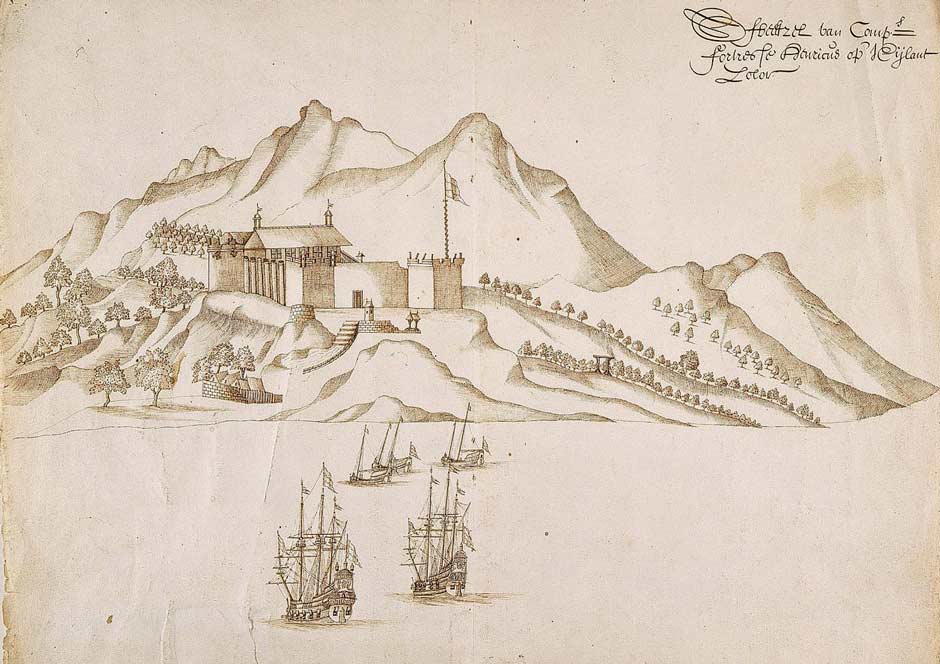
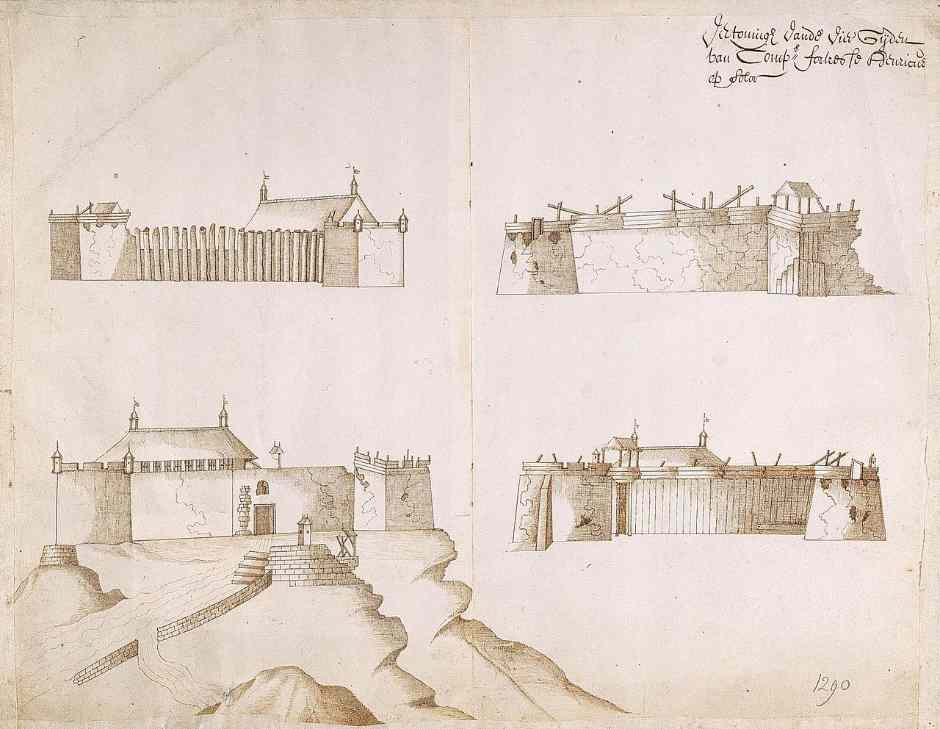
Above: A misleading view of Fort Henricus around 1656. Below: The four sides of Fort Henricus around 1656. (Afbeeltzel van 's Comps, Fortresse Henricus, op 't Eylant Zolor, Nationaal Archief, Amsterdam, Creative Commons)
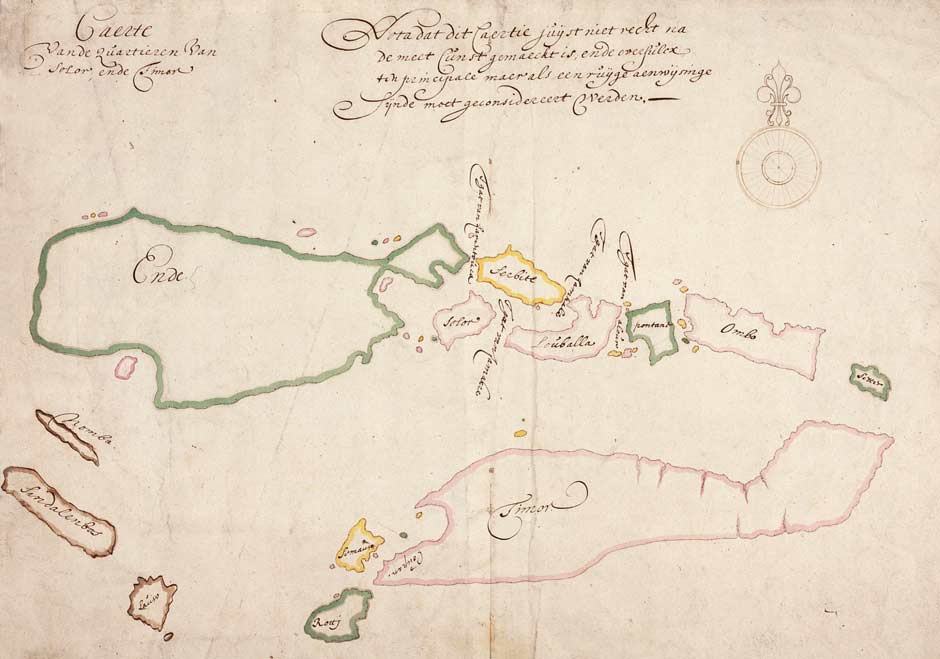
A crude map of the islands of Flores, Solor, Adonara, Lembata, Pantar, Alor, Timor, Savu and Sumba 1656. (Catalogus Leupe, National Archive of the Netherlands, Creative Commons Licence)
In 1660 Johan van Dam anchored his Dutch fleet of 33 ships at Loyahong before going on to bombard Portuguese Makassar. The Queen of Solor and many supporters came out to welcome them in two large boats, singing and playing flutes and gongs. The Solorese continued to come out to the fleet every day in their small boats attempting to trade food for cotton cloth. Following that visit, Fort Henricus ceased to have any major importance to either the Dutch or the Portuguese. The Dutch found that by now there were few white Portuguese in the Solor Archipelago and Timor but many of their followers – in other words the Topasses and others who had been in the service of the Portuguese (Andaya 2010, 405).
In an effort to monopolize the trade of Flores and the eastern islands of the Dutch, the VOC concluded the Treaty of Bongaai with the ruler of Goa at Makassar in 1667, which brought Bima under the control of the VOC and acknowledged the company's authority over the greater part of Flores. Henceforth other European powers were excluded from trading in this region. A Dutch postholder was placed at Braai (near Ende). As a postscript, the VOC concluded an agreement with the Sultan of Ternate in 1683 under which he formally ceded all his rights to Solor Island to the company.
VOC sources mention that elephant tusks appeared regularly as trade items on local trading vessels carrying other commodities and island-hopping in the eastern Indonesian seas to Flores, the Lamaholot areas in the Solor archipelago, Tanimbar, and Aru – all territories where elephant tusks were highly prized as bridewealth for forming marriage alliances (Noorduyn 1983, 103 and 109; De Roever 2002, 77). Traders from the western archipelago and Makassar appeared regularly in the main eastern Indonesian markets, which were located in the ports of Solor, Alor, and Aru (Rouffaer 1923/24, 206; Noorduyn 1983, 103–4).
Return to Top
Solor Alone
With the Dutch confined to Kupang, Solor was abandoned and left within the orbit of the Portuguese based at Larantuka. Yet it officially remained a Dutch territory and under its trade agreement continued to pay tribute to the VOC in Kupang, along with Semau, Rote, Savu and parts of Flores (Milius 2013, 121). The Rajas of each island came to Kupang every August or September with their entourage to pay their taxes of wax, sandalwood, slaves, turtles, gold dust and betel.
Faced with such strong Dutch opposition and harried by local Muslim communities, the Portuguese were struggling to justify the resources required to maintain and defend the Dominican mission on Flores. They were also concerned by the increasing control of the Topasses over the Timorese sandalwood trade.
Consequently in 1702, the white Portuguese relocated their government centre from Larantuka to Lifau in West Timor, leaving Larantuka in the control of the mestizo Black Portuguese (the Topasses or Larantuqueros) overseen by the de Hornay and de Costa families (Viola 2013, 11). On Solor, the only Black Portuguese presence was confined to the interior of the fort and to the small surrounding communities who had been converted to Christianity by the Dominicans (Newitt and Disney 1986, 58).
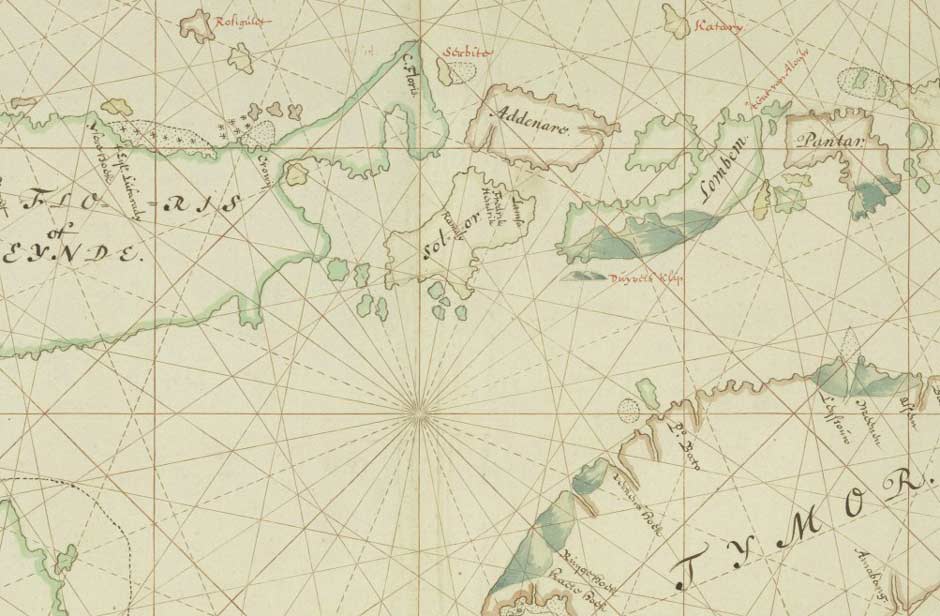
Kaart van Timor en de Kleine Soendasche Eilanden by Isaak de Graaf, dated between 1690 and 1743 (National Archive of the Netherlands Creative Commons Licence)
On Timor, Black Portuguese rule became increasingly oppressive, inciting a two-year tribal uprising in 1711 and another in 1727. Eventually in 1748 the northern Amfoan openly rebelled against the Topasses and sought assistance from the Dutch fort at Kupang. The Amanuban defected shortly afterwards. The better-armed Topasses brutally overwhelmed the rebels, forcing the leader of the Greater Sonbai to flee to Kupang along with many of his supporters. This further incensed the Topass leaders, who in November 1749 marched on Kupang to confront Dutch forces at Penfui (the site of modern Kupang airport). Despite being heavily outnumbered the Dutch-led troops devastatingly defeated the Black Portuguese army, consolidating their position in far-western Timor.
Building on their success, the VOC sought to formalise and extend their role in the region by establishing exclusive trading contracts with the Timorese and neighbouring rajas. In 1756, Commissioner Paravicini invited 49 rulers from Timor along with many rajas from the adjacent islands of Rote, Savu, Solor, Adonara, and Sumba to an elaborate conference in Kupang (Hägerdal 2024). This began with a preparatory meeting at a convention hall on 10 May. This was followed by a signing ceremony for 101 rulers on 9 June, culminating in an extravagant banquet. It seems likely that many local rulers had little understanding of what they had agreed to, while those in central and eastern Timor were more closely allied to the Portuguese than to the VOC in Kupang. It seems that the rajas of Lawajong and Lamakera on Solor and of Adonare, Lamahale and Terong on Adonara were gifted ceremonial silver-topped rottingknoppen walking canes embossed with the Dutch coat-of-arms.
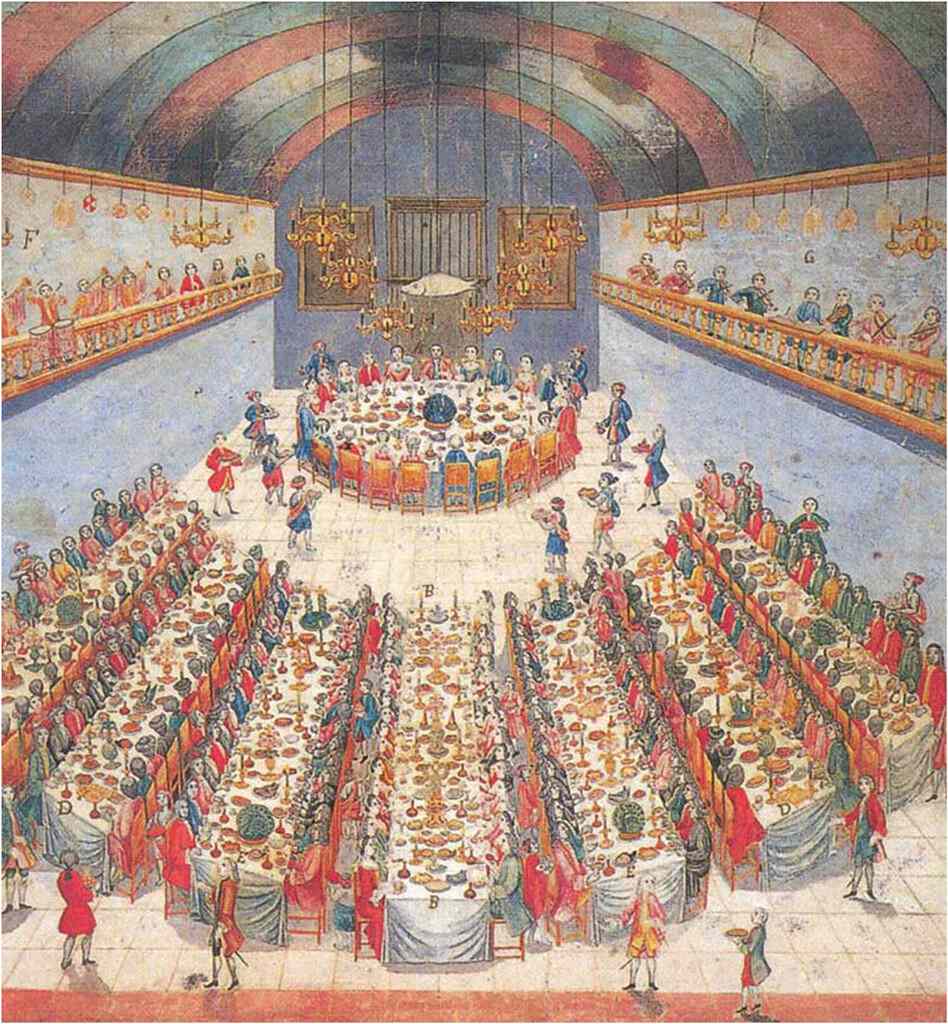
The banquet in Kupang on 9 June 1756, following the signing of the VOC contracts.
Despite this major effort to realign so many local rulers to the Dutch, events proceeded badly. Having lost the allegiance of the Sonbai, the Topasses responded with a combination of threats and promises. Unnerved, the Dutch misplayed their hand. They exiled the Sonbai chiefs and attacked the Amarasi, enabling the Topasses to swiftly rebuild their former alliances. Outmanoeuvred, the Dutch administration in Batavia quickly lost interest in far-flung Kupang.
In the meantime, having failed to establish a foothold in West Timor, in 1769, the Portuguese governor António Teles de Meeses abandoned Lifau and relocated to Dili.
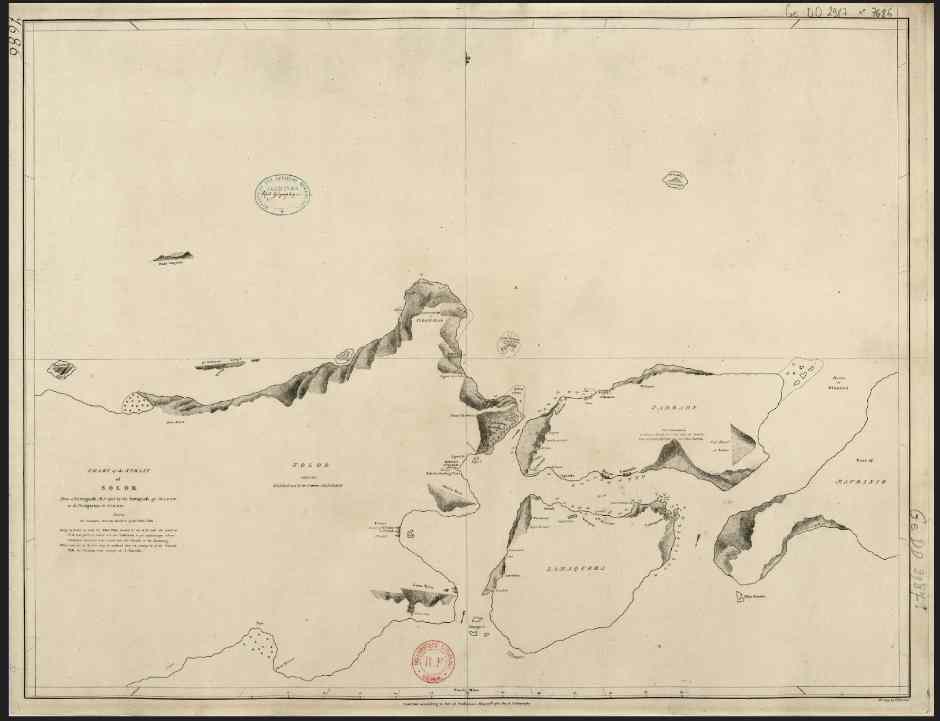
Chart of the Strait of Solor in 1781, used by the Portuguese of Macao to navigate to Timor. Solor Island is labelled Lamaquera after its main trading port. (Alexander Dalrymple, London, ca. 1792, National Maritime Museum, London)
Following the outbreak of war between Holland and Britain in 1780, the VOC was plunged into severe financial problems and lost its lines of credit (Gaastra 2007, 26). The Batavian Republic allowed the charter of the VOC to be extended to the end of 1798 and later to the end of 1800, after which it was then allowed to lapse (Gaastra 2007, 26). The VOC was declared bankrupt and its debts were taken over by the state.
Return to Top
Nineteenth Century Solor
For most of the nineteenth century, Dutch interests continued to be focussed on the north coast of Solor and especially the eastern Muslim villages of Lohayong, Menanga and Lamakera.
In 1825 the Triton Expedition, led by the German naturalist Salomon Müller, set off for the Dutch East Indies and New Guinea, arriving in Batavia in 1826. The expedition was arranged by the Natuurkundige Commissie, a group of naturalists sent to the Dutch East Indies to collect animals and plants for the National Museum of Natural History in Leiden. Sailing aboard the corvette HM Triton and accompanied by the schooner HM The Iris, they sailed to New Guinea via Ambon and Banda in early 1828, continuing to Kupang that October. They never visited Solor but while in Kupang, the expedition did encounter some of the island’s coastal inhabitants from the eastern villages of Lamakera and Lawajong (Lohayong), from whom they gathered some information about the island and its people.
The villagers claimed that their ancestors came from Buton and held a combination of Islamic and pagan beliefs (Müller 1839, 284-290). The men engaged in staged stick fights and performed a circle dance with their heads and bodies adorned with palm tree fronds.
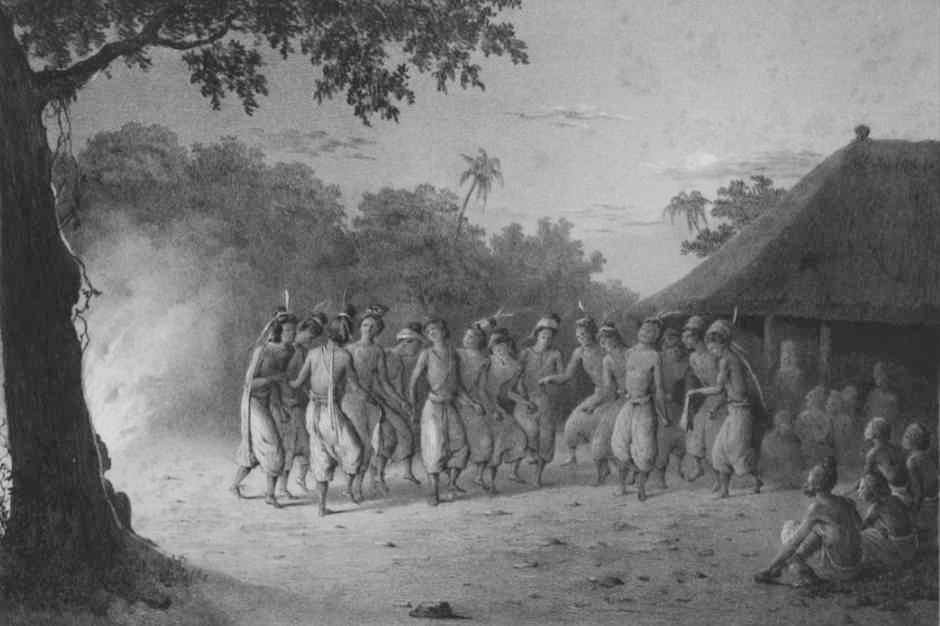
Dance of the natives of Solor. Verhandelingen over de natuurlijke geschiedenis der Nederlandsche Overzeesche Bezittingen, 1839-1844.
The local costume was quite distinct. Men wore shorts made of locally woven coarse, striped cotton with wide-sleeved shirts or shawl-like cloths. Women wore coarse, striped, dirty red, white and blue sarongs with their arms and necks decorated with rings of ivory, silver or yellow copper wire, shells and strings of beads. Warriors wore striped shorts, an armour of two thin boards embellished with sea shells, and plumes of cock’s feathers, goat hairs and red and white flags.
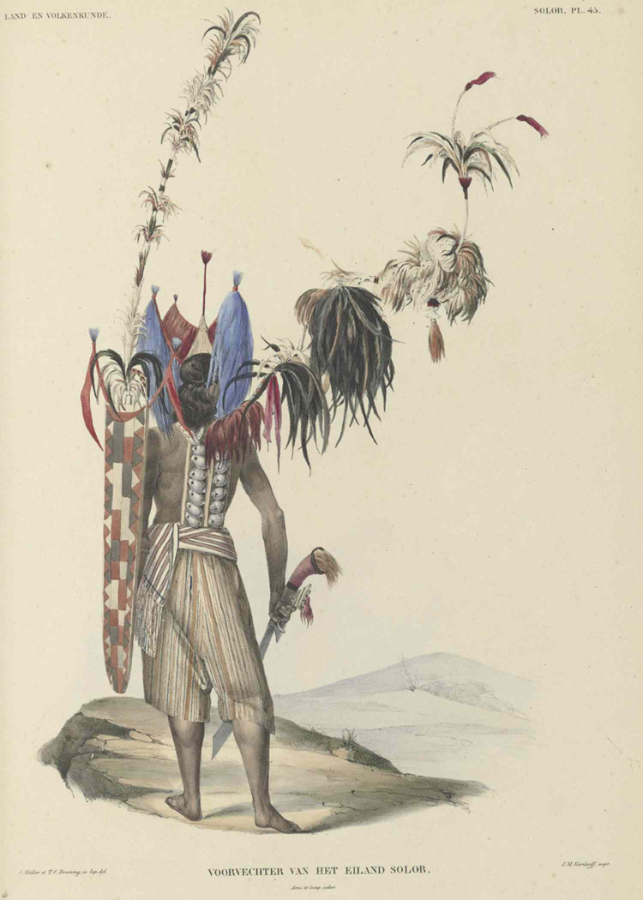
A champion warrior on Solor.
Coloured lithograph by S. Müller and T. C. Bruining, ca 1839.
Dirk Wouter Jacob Carel Baron van Lynden, who was the Dutch Resident of Timor from 1849 to 1852, left us a limited overview of Solor in his report of 1851. It is hard to judge the extensiveness of his knowledge, but it seems unlikely that he would have known about the more remote communities in the west. Apparently both Solor and Adonara were well populated and there were many slaves. Their populations were divided into the people of the coast (orang pantai) who seem to originate from Buton or Ternate and the people of the mountains (orang gunung). The coastal people were Muslim but the mountain dwellers were pagans.
Being newcomers, the coastal dwellers had no fields and engaged in fishing, while the mountain dwellers practiced slash and burn agriculture, equipped solely with iron-tipped digging sticks. They grew padi hill rice and maize (djagong). Goats were numerous and chickens could be found in most homes, while the chief of Lamakera had a few buffalo. The island also had wild deer and pigs.
The villages of the coastal people on Solor were very dirty and their houses were poorly built and disorderly. Houses across the island were built flat on the ground and accommodated four or five families. Well-to-do inhabitants displayed their wealth in the form of elephant tusks (bala). The latter were acquired in exchange for slaves, a 30- to 40-pound tusk being worth three good slaves.
Firearms were very rare, the main weapons being bows and arrows, knives, lances and wooden shields.
The Muslim coastal villages of Lohayong, Menanga and Lamakera in East Solor were under Dutch authority but Catholic Pamakayo and Wurej remained loyal to Portugal. The coastal people exerted a limited authority over the mountain dwellers, whose chiefs were titled attakabelak. The Muslim rajas of Lohayong and Lamakera were titled singgaji and owned Dutch silver-topped walking canes. They were supported by kapitans. Both locations were obliged to provision passing Dutch ships with water and in the event of war, fighters. Lohayong was the residence of the Dutch posthoulder.
In terms of local industry, there were a few blacksmiths and carpenters in the coastal villages making good boats, while others were firing earthenware pots. Salt was extracted from seawater at Lohayong and Wurej. Women were engaged in weaving and a few goldsmiths were producing gold and silver jewellery.
There was relatively lively inter-island trade. Barter markets selling rice, coconuts, goats, betel nut and other goods were held at Lohayong and Lamakera. These were attended by the mountain dwellers and the neighbouring islanders.
Long distance trade was in the hands of merchants from Buton, Ende and Kupang. In 1850 four perhaus from Kupang and eight from Buton imported padi rice, maize and cotton, while three perhaus from Ende imported just rice. Makassarese and Buginese merchants also came to trade from time to time. Goods exported from Solor included maize, rice, raw cotton bolls, coconut oil, whale oil from Lamalera and bird’s nests from Lohayong and Kawella on the southwest coast of Solor. Apparently Solor had plenty of cotton, locally called kapalolong, especially for export.
The people of Solor had an appetite for various imported textiles (van Lynden mentions serassa cloth from Gujarat or Masulipatam, kain korassi and kain lipat from Ende or Buton) and for silk yarns, especially yellow, red and white, which they wove into their cotton cloths. They also needed elephant tusks, ivory bracelets, copper wire for making fishhooks and bracelets, copper bowls, gongs (imported in sets of ten), red and white glass beads, iron, parangs, knives and guns and spices and alcohol.
In the ruins of Fort Henricus van Lynden found four remaining 10-pounder cannons but without their carriages.
Solor becomes a Dutch Possession
In 1839 the Dutch had bombarded Larantuka, suspecting that it harboured Endenese pirates. This event led to the opening of a dialogue between the Dutch authorities in Kupang and the Portuguese authorities in Dili concerning the disputed colonial sovereignty of East Flores, the Solor Islands and Timor. When José Lopes de Lima arrived as the new Governor of cash-strapped Dili in 1848, he set out to not only resolve the conflict over frontiers but at the same time to put the finances of his administration in order. In November 1851 he finalised an agreement with the Dutch Governor of Kupang, Baron von Lynden, to cede Flores, Solor, Adonara, Lembata, Pantar and Alor to the Dutch in return for the enclave of Oecussi in West Timor and Maubara and Atauru Island in East Timor. Because the islands ceded to Holland were larger than the territories ceded to Portugal, the Dutch would make a payment of 200,000 florins (Sousa Saidanha 1994, 38-39). Desperate for cash, Lopes de Lima immediately rescinded authority over Flores and the other Solor Islands in return for an 80,000 florins advance, opening the way for the Dutch to establish a military garrison at Larantuka. This opened in 1852 and was garrisoned with thirty-five men.
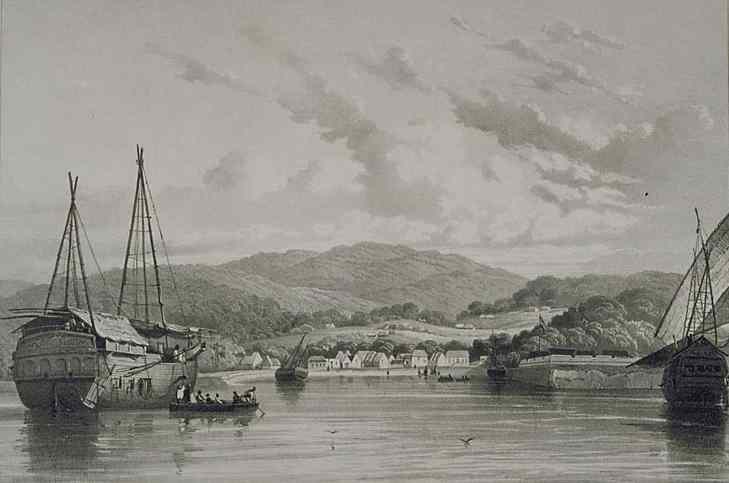
Kupang in 1844. C. W. M. van de Velde, Gezigten uit Neerlands Indie, naar de natuur geteekend en beschreven.
When the authorities in Lisbon received news about the agreement, they were furious and Lopes de Lima was recalled as a traitor but died at sea. However, his agreement could not be annulled and a formal treaty of demarcation was finalised in 1854 but only ratified in 1859 as the Treaty of Lisbon. Further minor conventions followed in 1893, 1904 and 1913, the 1904 agreement finally formalising the boundary between Dutch West Timor and Portuguese East Timor.
Whilst Solor and its neighbouring islands became Dutch possessions in 1859, the Dutch maintained a policy of non-interference, leaving the Raja of Larantuka responsible for part of the northwest coast of Solor and the Raja of Adonara responsible for the northeast and mountains of Solor. On 28 June 1861, the Raja of Larantuka and the Raja of Adonara signing Acts of Confirmation in which they recognised the authority of the Dutch. In 1863, Samuel Roos was installed at Larantuka as the first civiel gezaghebber (civil commissioner) of the ‘Solor Islands’ (Steenbrink 2021, 495). In 1866 he was replaced by J. M. Kluppel, who served until 1872 (Steenbrink 2021, 86). In 1869 the garrison in Larantuka was withdrawn, leaving Kluppel a powerless and isolated administrator. In the same year the Raja of Larantuka and the Raja of Adonara concluded a treaty of friendship.
In 1871, Kluppel penned a report on the status of the realms under his watch (Kluppel 1873, 378-398). He noted that on Solor Island there were two senior rajas, the Raja of Lamakera and the Raja of Lohayong, their territories both located on the northeast coast of the island. Generally, the so-called mountain people of Solor were pagans while the coastal people regarded themselves as Muslims, at least in name. The former grew maize, their main foodstuff, and hill rice, the amount of cultivated land having increased in recent years. The mountain women wove sarongs. The coastal dwellers were involved in little agriculture because their land was very rocky and infertile, the one exception being in the highlands of Pamakayo. The coastal people were fishermen and bartered their dried fish for maize and betel nut from the mountain dwellers at local markets. There was a general shortage of water on the island.
The Solorese people were warlike and there was often conflict between villages and even islands. Sometimes, a war between two villages arose because of the theft of one or two goats or something similar. When a few villagers had been murdered, their compatriots did not rest until they had killed an equal number or more of their opponents. The heads of the corpses were cut from the torso, tied to a bamboo pole and brought into their village with a great feast. Kluppel noted:
When in June 1869 continuous murders again took place between the people of Larantuka and the Soloreese, I returned to Larantuka from a visit to Lamahala and Lamakera and saw many people gathered close to the fort. Going there, I saw three decapitated bodies, around which some persons were dancing and jumping with great violence, shouting or singing revenge. The murdered were three innocent fishermen from Pamakayo, from the territory of the Raja of Larantuka.
Kluppel was superseded by L. O’Brien in 1872 and by E. F. Kleian in 1874. According to the Koloniaal Verslag for 1875, in the Solor Islands the mountain peoples claimed to be the original inhabitants, while the coastal peoples were of different origin and in some places spoke different languages (Koloniaal Verslag 1875, 27).
From 1876 onwards government steamships began to regularly visit Larantuka, linking it to other parts of the archipelago.
In 1885 J. M. Roos was appointed civiel gezaghebber of the Solor Islands and was replaced by L. M. Worms in 1886, who served until 1892. The posthouder on Solor from 1884-1886 was B. L. Kailola (Steenbrink 2003, 496).
It was around this time that efforts began to introduce Christianity to Solor Island. In August 1886 the Larantuka Pastor C. Ten Brink visited Solor accompanied by the Raja of Larantuka, Don Lorenzo. They visited a number of villages in western Solor and baptised a number of adults and children. The following year, Pastor H. Leemkers arrived and continued to visit the island annually for the next 10 years.
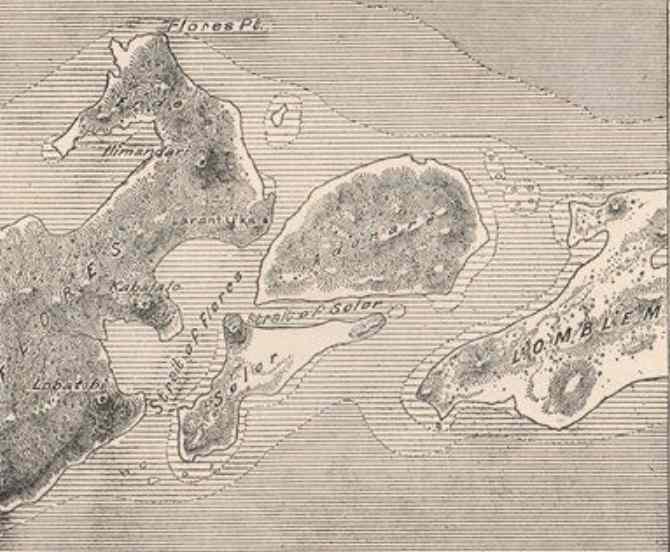
A crude map of Solor dated 1885.
The Universal Geography by Élisée Reclus, published by J. S. Virtue & Co., London
In 1888 Lamakera on Solor in alliance with Lamahala on Adonara attacked the village of Boleng in southeast Adonara, killing 47 people and capturing 62 (Barnes 1996, 25). Two Dutch gunships retaliated by bombarding Lamakera and Menanga on Solor and Lamahala, as well as the hapless Boleng.
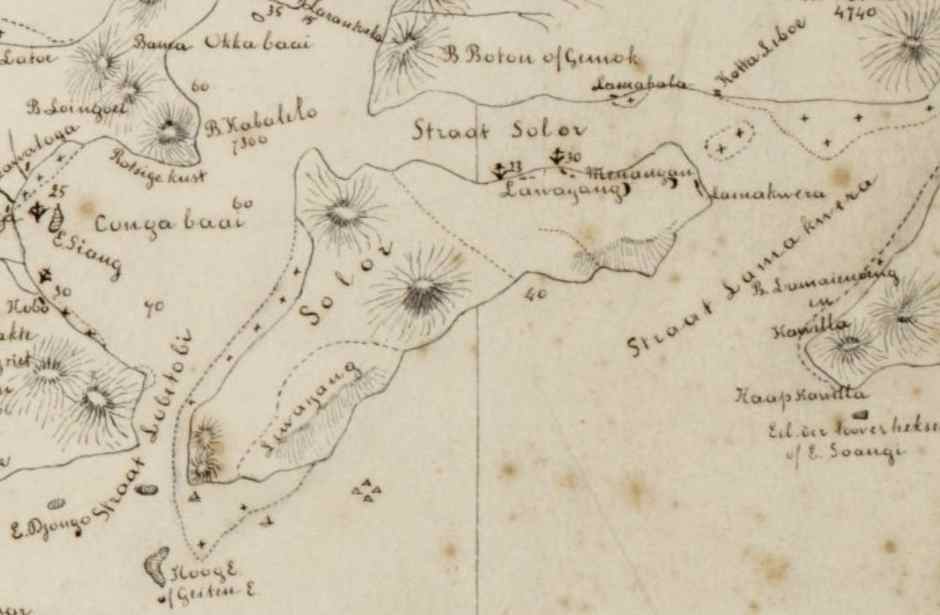
A detail of Solor from a map of Flores dated 1890 with anchorages marked at Lohayong and Menanga on the northeast coast.
In 1890, Ten Kate was commissioned by the Royal Dutch Geographical Society to travel through the East Indies and Polynesia, returning to Holland in mid-1893. In May 1891 he paid two brief visits to east Solor, crossing from the south coast of Adonara to Menanga. On his first visit he went to see the deferential Raja of Lamakera. On the second he went hunting for water buffalo. Whilst the fishing village of Lamakera looked picturesque from the sea, positioned in an amphitheatre of white hills, on the ground it was disgustingly dirty (1894, 238). Despite being nominally Muslim and having two mosques, the villagers had maintained their sacred stones, offering places and central ceremonial arena.
Return to Top
Twentieth Century Solor
In 1899 the naturalist Professor Max Carl Wilhelm Weber led a zoological and hydrographical expedition round the Dutch East Indies aboard the 50m long twin-screw gunboat Siboga, which was owned by the Dutch East India Military Marine Service. The expedition consisted of ten Dutch naval officers, 45 native crew, six scientists including Max and Anna Weber, and two personal servants. Anna Weber was the first woman scientist to take part in a major oceanographic expedition. The expedition left Surabaya in March 1899.
Towards the end of the expedition, the Siboga headed for Solor Island, where Weber was keen to study the whaling community at Lamakera. They arrived there on 6 February 1900 and departed on 8 February.
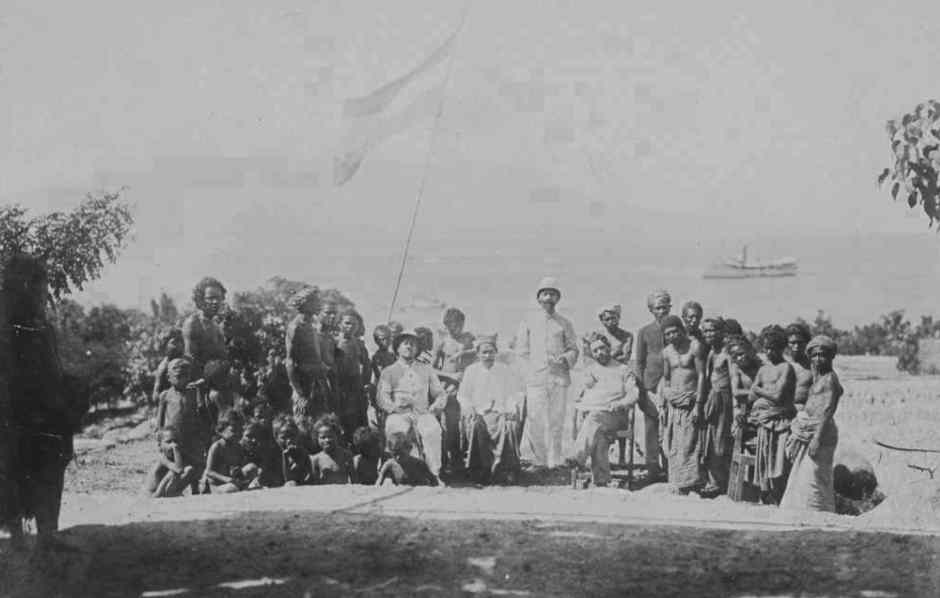
Weber with some of his colleagues and the Raja of Lamakera, February 1900.
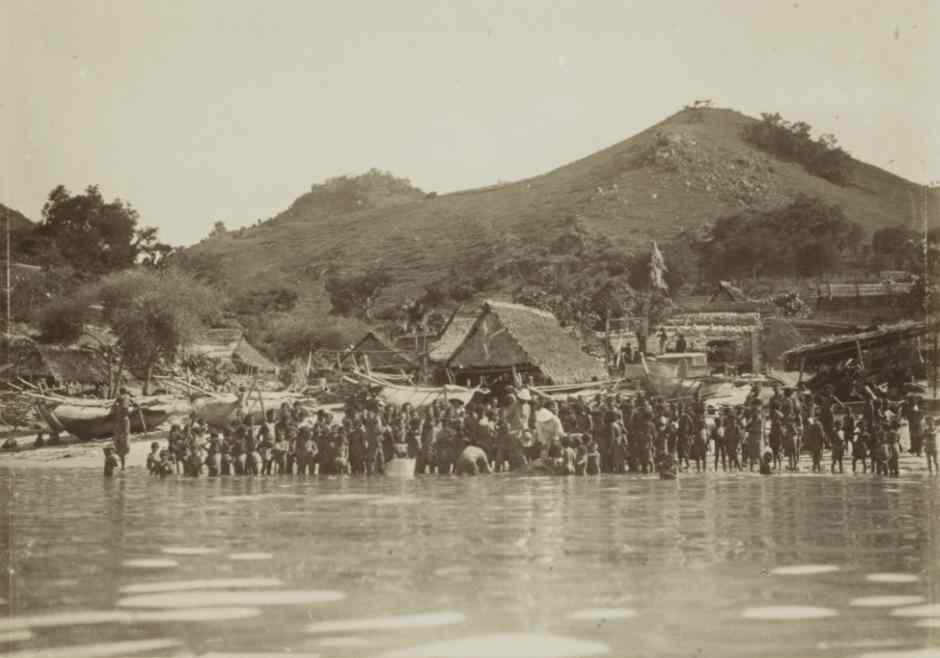
Weber reported that the large kampong of Lamakera was located in an amphitheatre on the side of a steep mountain that slopes down to the shallow bay (Weber 1902, 31-35). He estimated that it must have had over 2,000 inhabitants. As the Siboga arrived the crew spotted three rowing boats, towing a 6.5-meter-long baleen whale. The expedition found that during the hunt, the harpooner held a long bamboo pole fitted with a heavy iron harpoon, attached to the boat by a 15 to 20 feet long rope. On sighting a whale, the harpooner jumped onto the cetacean's back, driving the harpoon deep into its body. This caused the whale to dive, dragging the boat with it, whose crew were forced to swim to a nearby vessel. As soon as the whale and the boat resurfaced to breathe, other boats tied themselves to the first to tire out the captive whale. Given the many whale skulls offered to them for sale, the expedition judged that the number of whales that had been harpooned must have been very considerable.
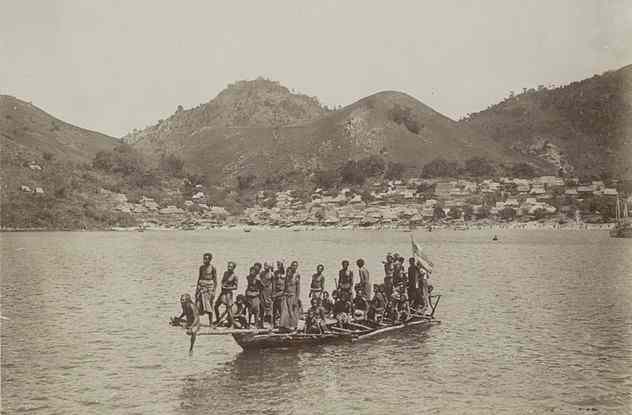
Above: A fully crewed whale boat just off shore from Lamakera. Below: Villagers on the beach by the boat sheds at Lamakera.
At the start of the twentieth century, the Rajas of Larantuka and Adonara were the two most powerful rulers in the Lamaholot region. As a crude generalisation, the Demon mountain people were allied with the Raja of Larantuka and the Portuguese, while the coastal Paji were allied to the Raja of Adonara and the Dutch. But change was coming fast.
In 1904 Colonel Joannes van Heutsz was appointed Governor-General of the Netherlands East Indies. Prior to that, from 1898 to 1903, he had headed a highly successful counter insurgency campaign that had finally gained control of the unruly Sultanate of Aceh, using light and flexible detachments of military police (marechaussee) recruited from Ambon and Java. Faced with numerous on-going local insurrections and acts of violence across the Outer Islands, van Heutsz realised that the Dutch had to abandon their former policy of non-interference. Stability and prosperity would require a completely new hands-on approach with the imposition of strong local rule.
The first official to implement this new and more active policy in the Lesser Sunda Islands was F. A. Heckler, who had taken over as Resident of Kupang in April 1902. The first problem he had inherited was in East Flores, where the troublesome Catholic Raja of Larantuka, Don Lorenzo II, had become engaged in territorial disputes with the Catholic Raja of Sikka and the Muslim Raja of Adonara (Steenbrink 2002a, 95). In July 1904 Heckler finally took action to depose Don Lorenzo, who was arrested and sent into exile in Yogyakarta. He was replaced by the more malleable Don Louis Balatran de Rosario, who signed the Short Declaration or Korte Verklaring, swearing allegiance to Holland. The civil administrator was J. Misero.
At the end of the same month, Sea Lieutenant L. van den Borg was sent to Sagu on the north coast of Adonara with 30 European and 30 native troops with orders to quash a native insurrection against Arakian Kamba, the Raja of Adonara.
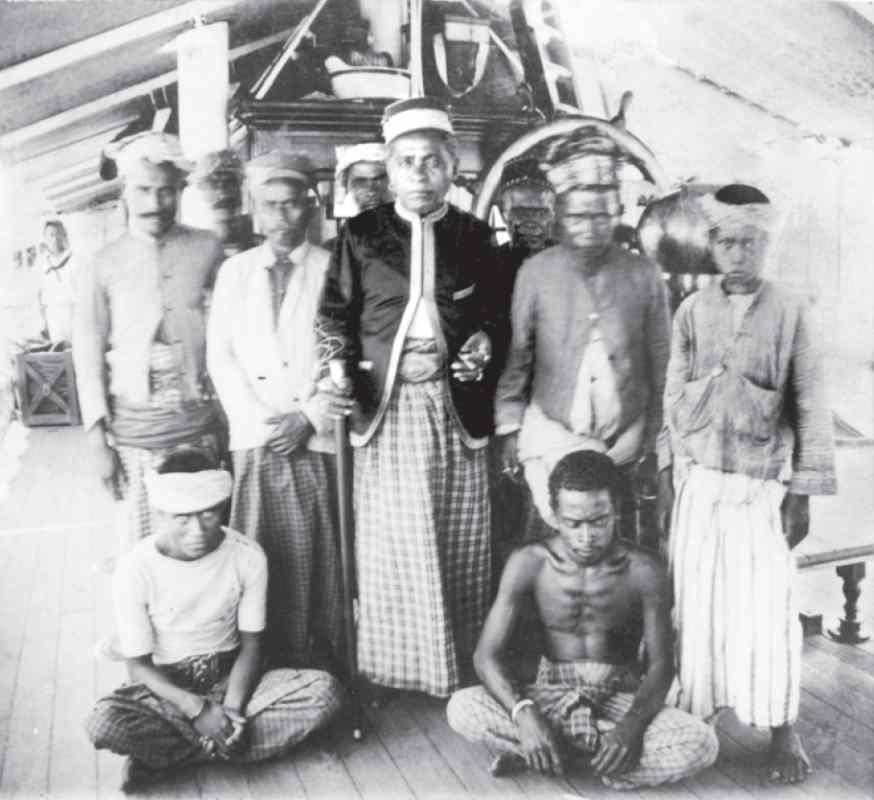
Arakian Kamba, Raja of Adonara (1894–1930), onboard Her Majesty’s ship van Doorn off the coast of Sagu circa 1905.
The next Resident of Kupang, J. F. A. de Rooy, who took over from Heckler in March 1905, was given clear instructions regarding this much more active policy. His main task was:
To establish a powerful authority in the whole residency, with the implication of a new strategy towards the self-ruling districts, which are the majority of the whole area. The former policy of non-intervention, suggesting that the supreme authority was with the native rulers and not with the colonial authority, should be abandoned (Steenbrink 2002b, 70).
In late 1906 de Rooy despatched A. J. L. Couvreur to Ende as the new Controleur of Flores, tasked with assessing the local security situation and establishing a firm administration throughout the region, including the islands of Adonara and Solor. With a civiel gezaghebber in Larantuka to administer East Flores, he installed a posthouder at Maumere to cover north Flores, a posthouder in Ende to cover south Flores and a posthouder in Waiwerang on Adonara, to cover Adonara and Solor Island (Metzner 1982, 71).
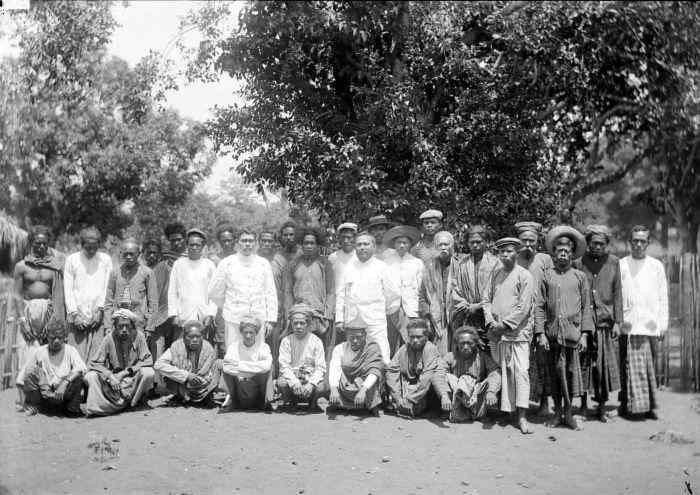
The Civiel Gezaghebber of Larantuka, First Lieutenant of the Infantry J. G. van den Bossche, with Renier Theedens and the heads (kakang) of East Flores, Solor and Adonara around 1908 (Tropenmuseum Creative Commons)
In 1909 Flores was divided into six subdivisions or onderafdeeling: Manggarai, Ngada, Ende, Maumere, East Flores and the ‘Solor Islands’ (Solor, Adonara and Lembata), thus aligning the administrative divisions more in-line with the rajadoms (Lewis 2006, 201).
It took until 1910 for the Dutch to exert a limited degree of control over Solor, registering the population and confiscating their weapons and firearms. Captain J. D. H. Beckering was dispatched to the East Flores division with a company of troops, spending eight days on both Adonara and Lembata (Beckering 1911, 1). It is not clear how many days he spent on Solor. He found that the merchants of Lamakera were some of the chief arms dealers to the other Paji regions. Beckering commented that the western half of Solor, nominally within the realm of the Raja of Larantuka, was ruled by two kakangs: based at Pamakayo in the north and Lewolein in the south. The Raja of Larantuka was subsequently tasked with collecting taxes from reluctant village leaders on Solor, as a result of which he was ambushed by enraged villagers and nearly killed at Ongalering in 1914.
As a result of the Dutch changes, the power of the Raja of Larantuka was much reduced, while that of the Raja of Adonara was considerably strengthened. Beckering wrote (Beckering 1911, 171):
Adonara is today the strongest small state, his Raja has the highest authority and is feared by others.
1906
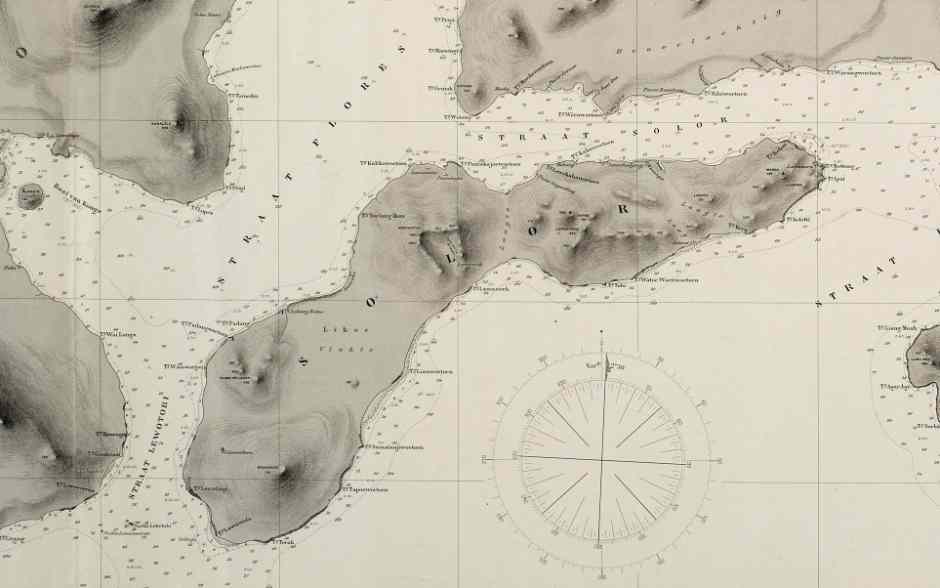
A topographic map of Solor based on Dutch surveys of 1906 and 1908
In 1914 Solor was placed under a civiel gezaghebber based in Larantuka, while Adonara and Lembata were formed into a separate subdistrict under a different gezaghebber at Waiwerang (Barnes 1996, 381).
During the 1920s, Catholic missionaries from Larantuka intensified their efforts to proselytise the people of west Solor. In 1923, Father Theodorus Koch arrived as the first SVD missionary to Lewolein, visiting the villages of West Solor every two months, sometimes with other colleagues from Larantuka (da Santo 2006). It seems that the northern villages of Solor were visited by members of the Adonara mission.
In March 1929, the German ethnographer Ernst Vatter and his wife Hanna travelled with Father Koch on the government motorboat from Flores to the southwest coast of Solor. With the help of local porters, they climbed from the beach to the small inland village of Lewolein. The whole south of the island was sparsely populated with about 2,000 to 3,000 people spread across just over a dozen villages. The houses were built on stilts but were smaller and less well-kept than those across the Strait at Lobe Tobi. Rice and corn fields were surrounded by bamboo fences to protect them against the goats and pigs.
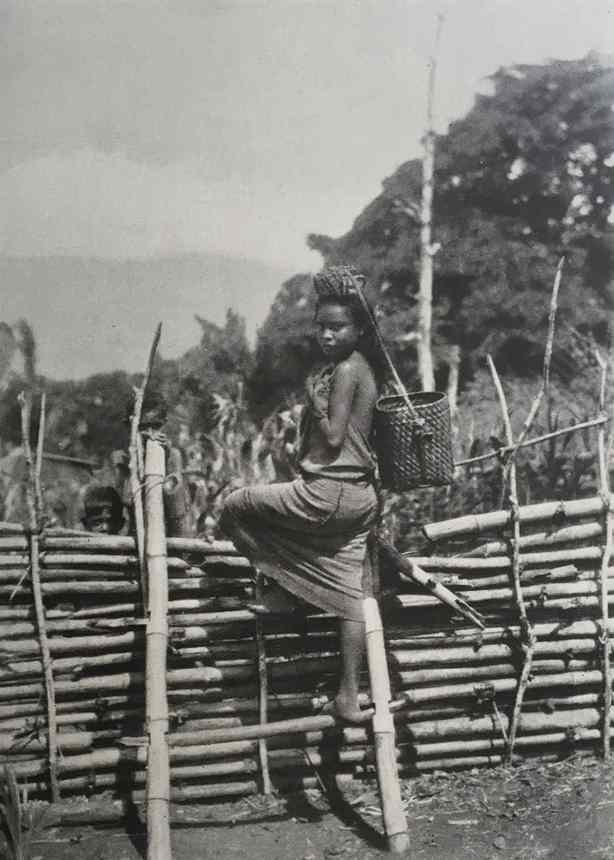
A native of Lewolein crossing a bamboo fence. Photographed by Ernst Vatter in 1929.
From Lewolein the Vatters travelled north to the terraced village of Balawelin, surrounded by black boulders and tiny corn fields and the mountain village of Ongalereng. It seems that at this time, these villages were not so close to the coast as they are today.
In 1929, Lohayong and in 1931 Lamakera, both formerly under the authority of the Raja of Adonara, were placed under the Raja of Larantuka.
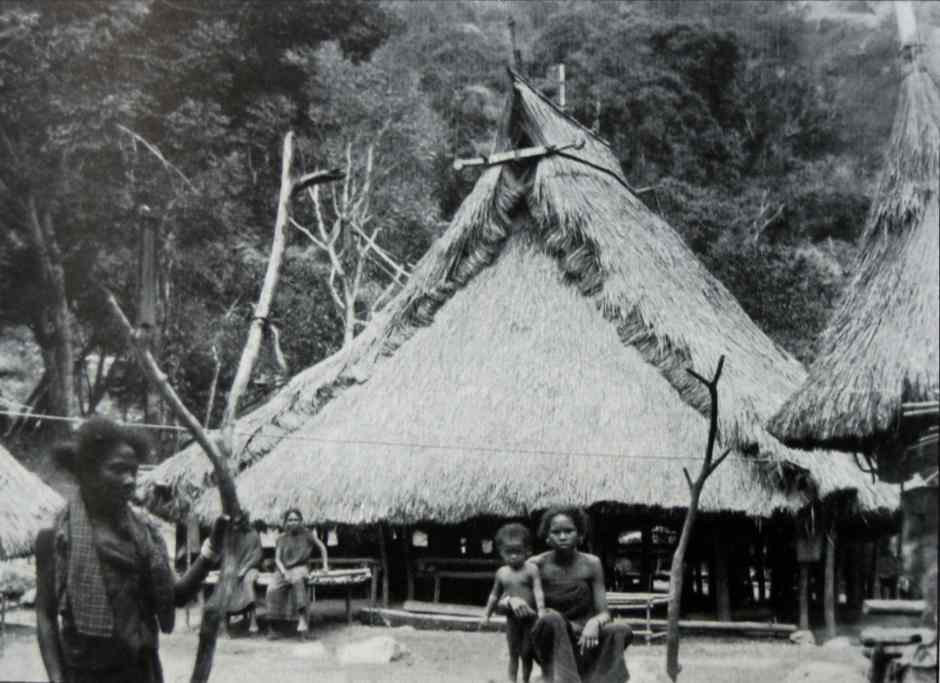
The house of Buas in Lamawolo with a carved and painted pediment bracket under the ridge. Vatter 1929. Below: The village temple in Balawelling with carved and painted support posts. Vatter 1929.
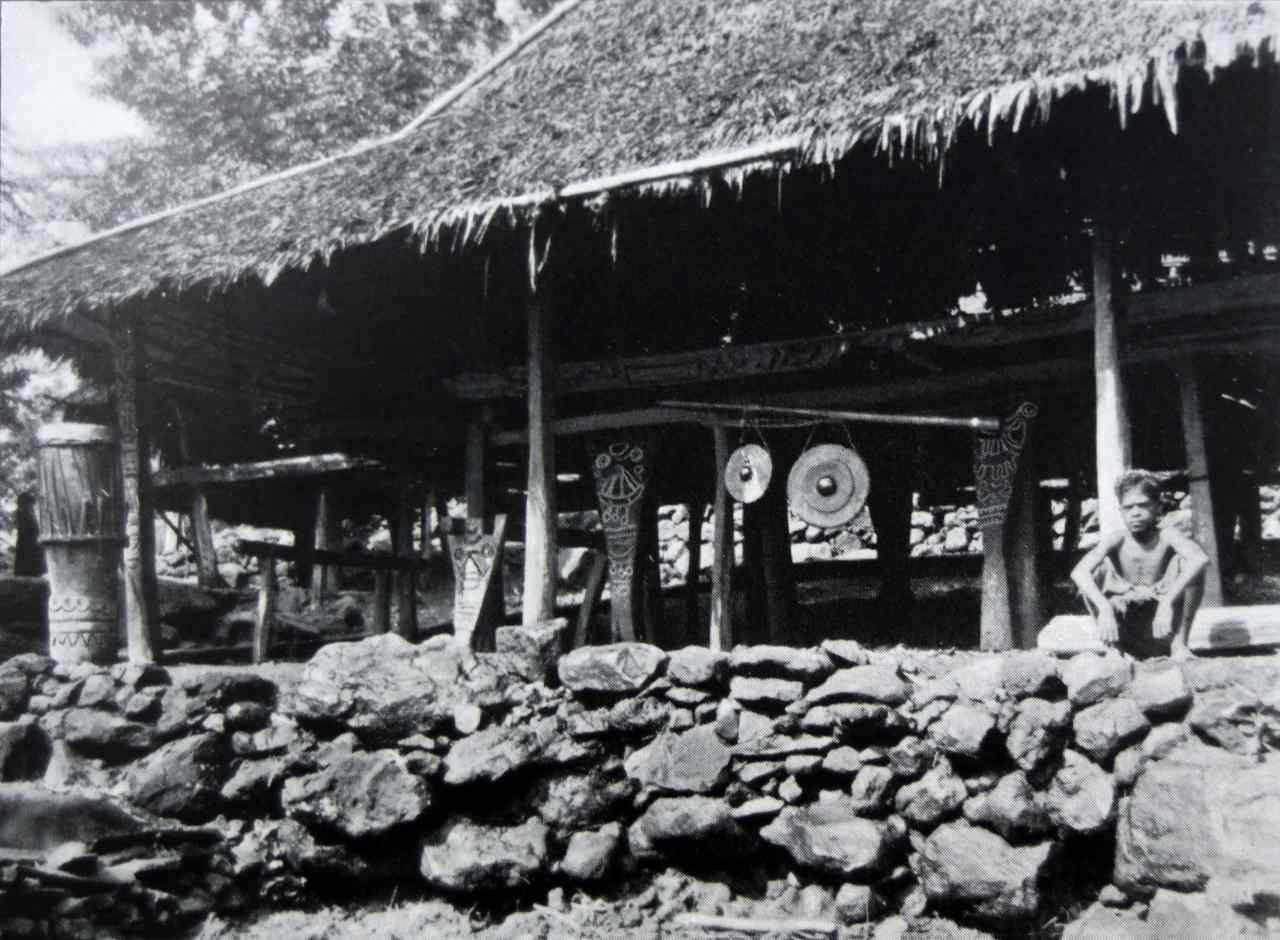
A little later, during the 1930s, the missionary Paul Arndt noted that the villagers of Lewolein in southwest Solor had already begun seeking work and income abroad. Under the Dutch, Lewolein and its neighbouring villages were now loosely administered as a cluster, collectively known as Hamente Lewolein, a hamente being the smallest type of administrative unit.
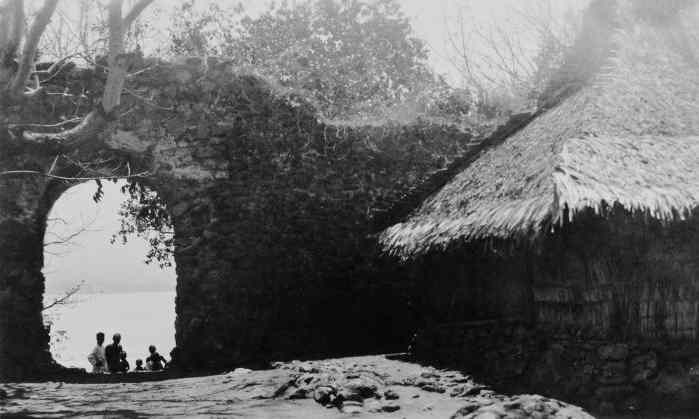
The north entrance to the Solor fort, photographed between 1930 and 1936
(Tropenmuseum Creative Commons)
Bibliography
Abdullah, Anzar, and Wekke, Ismail Suardi, 2018. Origins of Islam in Indonesia, International Journal of Pure and Applied Mathematics, vol. 119, no. 18, pp. 1149-1179.
Abdurrachman, Paramitha R., 2008. Bunga Angin Portugis di Nusantara: Jejak-jejak Kebudayaan Portugis di Nusantara, Yayasan Pustaka Obor Indonesia, Jakarta.
Andaya, Leonard Yuzon, 2010. The ‘informal Portuguese empire’ and the Topasses in the Solor archipelago and Timor in the seventeenth and eighteenth centuries, Journal of Southeast Asian Studies, vol. 41, no. 3, pp. 391-420.
Anon., 1895. Dr. Ten Kate's Travels in the Indian Archipelago, The Geographical Journal, vol. 5, no. 2, pp. 163-165.
Aritonang, Jan Sihar, and Steenbrink, Karel, 2008. The Solor-Timor Mission of the Dominicans, 1562–1800, A History of Christianity in Indonesia, Brill, Leiden.
Arndt, Paul, 1951. Religion aus Ostflores, Adonare und Solar, Studia Instituti Anthropos, vol.1, Verlag und Druck der Missiondruckerei St. Gabriel, Wien-Mödling.
Arndt, Paul, 1993. Falsafah dan Aktivitas Hidup Manusia di Kepulauan Solor, Puslit Candraditya, Maumere.
Arndt, Paul, 2002. Demon dan Paji: Dua bersaudara yang bermusuhan di Kepulauan Solor, Puslit Candraditya, Maumere.
Badan Pusat Statistik Kabupaten Flores Timur, 2024. Flores Timur dalam anka 2025, Larantuka.
Barnes, R., 1987. Avarice and iniquity at the Solor Fort, Bijdragen tot de Taal-, Land- en Volkenkunde, vol. 143, no: 2/3, pp. 208-236, Leiden.
Barnes, R. H., 1995. Lamakera, Solor: Ethnohistory of a Muslim Whaling Village of Eastern Indonesia, Anthropos, vol. 90, pp. 497-509.
Barnes, R. H., 1996. Lamakera, Solor: Ethnographic Notes on a Whaling Village of Eastern Indonesia, Anthropos, vol. 91, pp. 75-88.
Baron van Lynden, D. W. C., 1851. Eilanden-Groupen van Solor en Alor, Bijdrage tot de Kennis van Solor, Allor, Rotti, Savoe en Omliggende Eilanden, Natuurkundig Tijdschrift voor Nederlandsch Indië, Lange & Co., Batavia.
Beckering, J. D. H., 1911. Beschrijving der eilanden Adonara en Lomblem, behoorende tot de Solor-Groep, Tijdschrift van het Koninklijk Nederlandsch Aardrijkskundig Genootschap, 2e Série, vol. 28, pp. 167-202.
Bellwood, Peter, 1997, Prehistory the Indo-Malaysian Archipelago, revised edition, University of Hawaii Press, Honolulu.
Bellwood, Peter, 2007. Prehistory of the Indo-Malaysian Archipelago, second edition, ANU Press, Canberra.
Bintarti, D. D., 1997. Typology and distribution of the Pejeng type kettledrums, Proceedings of the 4th Conference of the European Association of Southeast Asian Archaeologists, Rome.
Cacegas, Luis, and Luis de Sousa, 1678. Historia de S. Domingos Particular Do Reino E Conquistas de Portugal, vol. 3, de Vinha, Lisbon.
Calò, Ambra, 2009. The distribution of bronze drums in early Southeast Asia: trade routes and cultural spheres, British Archaeological Reports, Archaeopress, Oxford.
Coolhaas, W. Ph., 1960. Generate Missiven van Gouverneurs-Generaal en Raden aan Heren XVII der Verenigde Oostindische Compagnie, vols 1 (1610-1638) and 3 (1655-1674), Nijhoff, The Hague.
Cortesão, Armando, 1975. O Descobrimento da Australásia e a “Questão das Mulucas”, Esparsos, vol. 1, pp. 263-342, Acta Universitas Conimbrigenis, Coimbra.
Dietrich, Stefan, 1984, 'A Note on Galiyao and the Early History of the Solor-Alor Islands', Bijdragen totde Taal-, Land- en Volkenkunde 140-2/3, pp. 317-326
Freycinet, M. Louis de, 1828. Voyage Autour du Monde fait par Ordre du Roi, Pillet Ainé, Paris.
Gaastra, Femme, 2007. De geschiedenis van de VOC, Walburg Pers, Zutphen.
Hägerdal, Hans, 2024. Enlightenment and Genocide: Johannes Andreas Paravicini’s Mission on Timor in 1756, Diplomatica, vol. 6, no. 2, pp. 258-283.
Hamilton, Alexander, 2013. A New Account of the East Indies, Being the Observations and Remarks of Capt. Alexander Hamilton, vol. 2, Cambridge University Press, Cambridge.
Heereken, H. R. van, 1958. The Bronze-Iron Age of Indonesia, Martinus Nijhoff, The Hague.
Heeres, J. E., 1907. Corpus Diplomaticum Neerlando-Indicum, Eerste Deel (1596-
1650) and Tweede Deel (1650-1675), Bijdragen totde Taal-, Land-en Volkenkunde
van Nederlandsch-Indie, vol.57, pp. I-XXXII, 1-586.
Herin, Jacob J., 2008. Lewo Mayen Tana Doen: Kebudayaan suku Lamaku dan Lamaole di Pulau Solor, Silvia, Denpasar.
Keraf, Gregorius, 1978. Morfologi Dialek Lamalera, Percetakan Offset Arnoldus, Ende, Flores.
Kluppel, J. M., 1873. De Solor-Eiland, Tijdschrift voor Indische Taal-, Land- en Volkenkunde, vol. XX, Series vol. III, pp. 378-398.
Kroon, Yosep Bisara, 2016. A Grammar of Solor-Lamaholot, A language of Flores, Eastern Indonesia, Doctoral Thesis, University of Adelaide.
Lach, Donald F., and van Kley, Edwin J., 1998. Asia in the Making of Europe: A Century of Advance: Southeast Asia, vol. III, book 3, University of Chicago Press.
Le Roux, C. C. F. M., 1929. De Elcano' s tocht door den Timorarchipel met Magalhaes' schip ‘Victoria', Festbundel Koninklijk Bataviaasch Genootschap, vol. 2, pp. 1-99, Weltevreden.
Le Roux, C. C. F. M., 1942. De Madjapahitsche Onderhoorigheden Hutan Kadali en Gurun en de oude naam voor het eiland Flores, Tijdschrift van het Koninklijk Nederlandsch Aardrijkskundig Genootschap, series 2, vol. 59, pp. 915-927.
Lewis, E. D., 2006. From Domains to Rajadom: Notes on the History of Territorial Categories and Institutions in the Rajadom of Sikka, Sharing the earth, dividing the land: land and territory in the Austronesian world, ANU Press, Canberra.
Lipson, Mark; Loh, Po-Ru; Patterson, Nick; Moorjani, Pria; Ko, Ying-Chin; Stoneking, Mark; Berger, Bonnie; and Reich, David, 2014. Reconstructing Austronesian population history in Island Southeast Asia, Nature Communications, vol. 5, article no. 4689.
Loureiro, Rui Manuel, 2005, Early Portuguese perceptions of the "Dutch threat" in Asia, Rivalry and Conflict: European Traders and Asian Trading Networks in the 16th and 17th Centuries, pp. 166-187, Amsterdam University Press, Amsterdam.
Lynden, D. W. C. Baron van, 1851, Bijdrage tot de Kennis van Solor, Allor, Rotti, Savoe en Omliggende Eilanden, Getrokken uit een Verslag van de Residentie Timor, Natuurkundig Tijdschrift voor Nederlandsch-Indië, vol. 2, pp. 317-336 and 388-414.
Metzner, Joachim K., 1982. Agriculture and population pressure in Sikka, Isle of Flores A contribution to the study of the stability of agricultural systems in the wet and dry tropics, The Australian National University, Canberra and Miami.
Milius, Pierre Bernard, 2013. Pierre Bernard Milius: last commander of the Baudin Expedition: the journal 1800 – 1804, National Library of Australia.
Müller, Salomon, 1857. Reizen en onderzoekingen in den Indischen Archipel, vol. 1, Frederik Müller, Amsterdam.
Murtadlo, Muhammad, 2016. Situs Menanga Solor Flores Timur: Jejak Islam di Nusa Tenggara Timur (NTT), Cerita Meneliti, pp. 97-124, GP Press, Jakarta.
Newitt, Malyn, and Disney, Anthony, 1986. The First Portuguese Colonial Empire, University of Exeter Press.
Noorduyn, J., 1983. De Handelsrelaties van het Makassaarese Rijk Volgens de Notitie van Cornelis Speelman uit 1670, Nederlandse Historische, vol. 3, pp. 96-123, Brennen.
Pigeaud, Theodore G. Th., 1960. Java in the 14th century, a study in cultural history, vol. III, p. 17.
Pigeaud, Theodore G. Th., 1962, Java in the 14th century, a study in cultural history, vol IV, p. 34.
Pires, Tome, 1944. The Suma Oriental of Tome Pire, 2 vols., Armando Cortesao, ed., The Hakluyt Society, London.
Roever, Arend G. de., 2002. De jacht op sandelhout. De VOC en de tweedeling van Timor in de zeventiende eeuw, Walburg Pers, Zutphen.
Roever, Arend G. de., Roever 2005. The warlords of Larantuka and the Timorese sandalwood trade, Rivalry and conflict; European traders and Asian trading networks in the 16th and 17th centuries, pp. 219-31. Leiden: CNWS Publications.
Rouffaer, G. P., 1923-24a. Naschrift over het Oud-Portugeesche Fort op Poeloe Ende; en de Dominikaner Solor-Flores-Missie, 1561-1638', Nederlandsch-Indie Oud en Nieuw, vol. 8, pp. 121-128 and 141-148.
Rouffaer, G. P., 1923-24b. Chronologie der Dominikaner-Missie op Solor en Flores, vooral Poeloe Ende (ca. 1556-1638), Nederlandsch-Indie Oud en Nieuw, vol. 8, pp. 204-222 and 256-260.
Santo, Francis Emanuel da, 2006. Ritaebang: The Beginning of the Voice of the Word CALLING, Following the Word: Memories of Pancawindu Imamat P. Dr. Nikolaus Hayon, SVD.
Schouten, Wouter, 1676. Wouter Schoutens Oostindische Voyagie, Meurs and van Someren, Amsterdam.
Sousa Saidanha, Joao Mariano de, 1994. The Political Economy of East Timor Development, Pustaka Sinar Harapan, Jakarta.
Spriggs, Matthew, and Miller, Danny, 1988. A Previously Unreported Bronze Kettledrum from the Kai Islands, Eastern Indonesia, Bulletin of the Indo-Pacific Pre-History Association, vol. 8, pp. 79-89.
Spriggs, Matthew, 2003. Chronology of the Neolithic transition in Island Southeast Asia and the Western Pacific: a view from 2003, The Review of Archaeology, vol. 24, no. 2, pp. 57-89.
Ten Kate, Dr. Herman F. C., 1894. Verslag eener Reis in de Timorgroep en Polynesië, Flores, Adonara and Solor, Tijdschrift Kon. Nederlandsch Aardrykskundig Genootschap, Tweede Series, vol. XI, pp. 195-246, Brill, Leiden.
Teysmann, J. E., 1874. Verslag eener Botanische Reis over Timor en de daaronder Ressorteerende Eilanden Samauw, Alor, Solor, Floris en Soemba, Natuurkundig Tijdschrift voor Nederlandsch-Indië, vol. 34, pp. 348–517.
Thomaz, Luis Filipe F. R., 1995. The image of the Archipelago in Portuguese cartography of the 16th and early 17th centuries, Archipel, vol. 49, pp. 79-124.
Tiele, P. A., ed. 1886. Bouwstoflen voor de geschiedenis der Nederlanders in den Maleischen Archipel, vol. 1. 's-Gravenhage.
Tiele, P. A. and Heeres, J. E. (eds.), 1886-1895. Bouwstoffen voor de geschiedenis der Nederlanders in den Maleischen Archipel, M. Nijhoff, ‘sGravenhage.
Vatter, Ernst, 1932. Ata Kiwan: unbekannte Bergvölker im tropischen Holland, ein Reisebericht, Bibliographisches Institut, Leipzig.
Viola, Maria Alice Marques, 2013. Presença histórica “portuguesa” em Larantuka (séculos XVI e XVII) e suas implicações na contemporaneidade, New University of Lisbon.
Weber, Max, 1902. Siboga-Expeditie: Introduction et Description de l’Expedition, E. J. Brill, Leiden.
Widjojo, M. S., 2008, The Revolt of Prince Nuku, Cross-cultural Alliance-making in Maluku, c.1780-1810, TANAP Monographs on the History of Asian-European Interaction, vol. 12.
Xu, Shuhua; Pugach, Irina; Stoneking, Mark; Kayser, Manfred; Jin Li; Phipps, Maude, and the HUGO Consortium, 2012. Genetic dating indicates that the Asian–Papuan admixture through Eastern Indonesia corresponds to the Austronesian expansion, Proceedings of the National Academy of Sciences of the United States of America, vol. 2, pp. 1- 7.
Return to Top
Publication
This webpage was published on 8 April 2026.