Asian Textile Studies
Contents
Ata Déi Textiles - 2
Women’s and Men’s Costume
Petak Alé
Petak Harén
Petak Harén Nai Telu
Petak Harén Nai Rua
Petak Kwae Tuan
Petak Hareen Nai Léém
Men's Costume
Bibliography
Ata Déi Textiles - 1
Introduction
Cotton and its Preparation
Natural Dyeing
Binding and Weaving
Women’s and Men’s Costume
The first description of Ata Déi costume was provided by Ernst Vatter, who visited the region along with his wife Hanna in June 1929. Unfortunately the description he penned was sparse. He noted:
The costume is still fairly undeveloped, men ane women wear the self-woven sarong, the upper body usually remains uncovered.
A lot is woven, but only a little ikatted.
These concise comments were confirmed by the eight black and white photographs that he left us. The women were all bare-breasted and were dressed in simple sarongs that were either plain woven or deorated with narrow warp stripes.
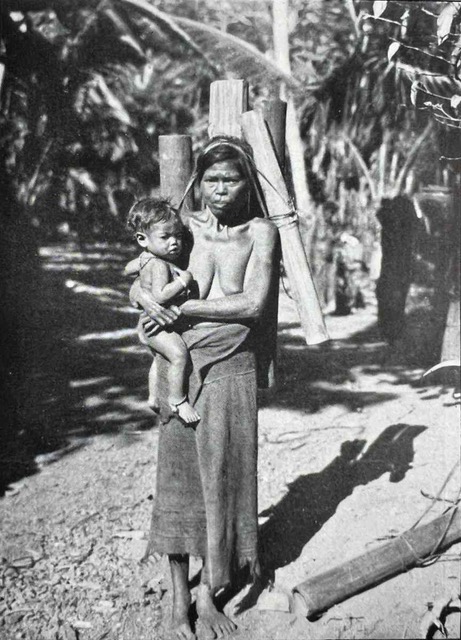
A mother wearing a ragged plain woven tube skirt.
The only man shown was bare-chested, wearing a voluminous plain-woven sarong, while young boys wore smaller narrow warp striped sarongs, although one was dressed in a chequered cotton cloth that was obviously imported.
One of his images showed a woman sewing together the two panels of a man's sarong (referred to as a nowin). The panels had narrow warp stripes and were similar to the men's cloths that had been woven at least up to the 1970s.
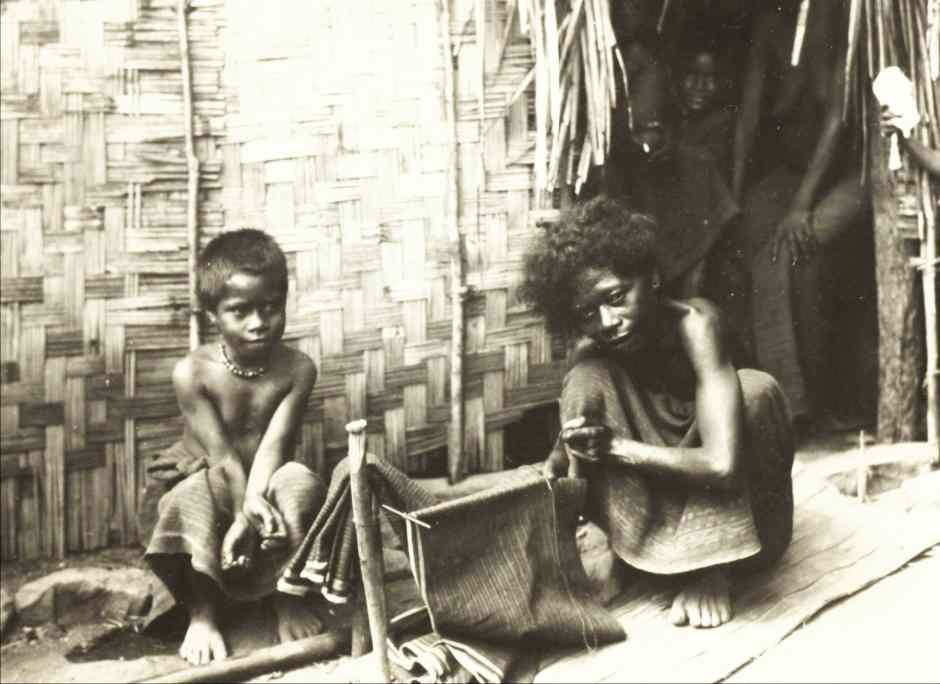
A mother sewing together a man's nowin. Her own sarong has simple ikat stripes.
Despite Vatter's comments, some very high quality ikat was being produced in the region at that time, albeit in limited quantities. Ernst and Hanna Vatter collected a three-panel ‘petak harin’ [sic] (meaning good sarong) that had been made by a member of the Lamahaku clan in the village of Lewokoba, located north of Watuwawer.
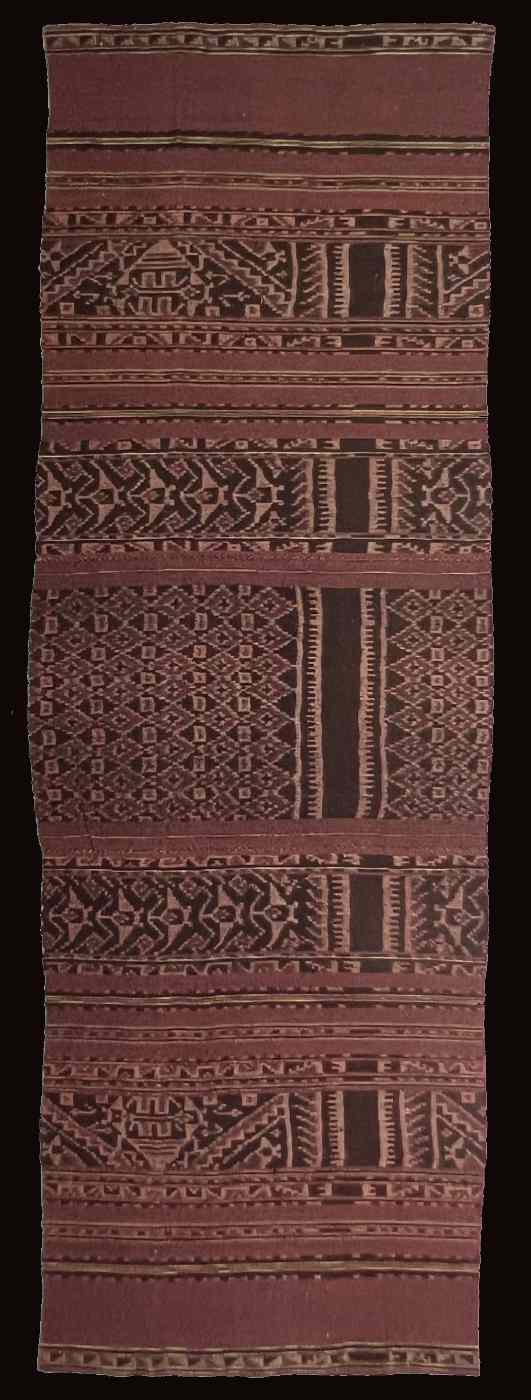
The ‘petak harin’ sarong collected in Lewokoba by Ernst Vatter in June 1929
Very similar sarongs are still being made on Ata Déi today
It is likely that such textiles were being made for ceremonial wear or for bridewealth exchange, possibly by women belonging to aristocratic clans or the wives of clan leaders.
A short review of the textiles worn by women on the Ata Déi Peninsula was provided by Ruth Barnes some 55 years later in her 1984 doctoral thesis, published in 1989 as The Ikat Textiles of Lamalera (Barnes 1984, 202-205; Barnes 1989, 96-99).
According to Barnes, the Ata Déi woman's tubular sarong was called a petak. There were two basic types:
- the petak alé used for everyday wear or for feast days and
- the petak harén used for bridewealth exchange.
Men wore a dark coloured nowi with thin, lighter coloured warp stripes.
Regarding the colours found in Ata Déi cloths, Ruth Barnes noted that the indigo used in the ikat pattern was always overdyed with morinda to produce a purplish-black (1984, 204). Consequently, the colour palette was simpler than that of the sarongs from Lamalera, consisting of just off-white, red and dark brown or black. However, this is not a hard and fast rule – we have found a few examples of Ata Déi sarongs that have been decorated with indigo highlights.
Furthermore, the ikat motifs in Ata Déi cloths tended to be starker, bolder and larger than those found elsewhere on Lembata. Some motifs were passed down from mother to daughter and were considered the property of the family, although not of the clan.
Return to Top
Petak Alé
We suspect that the traditional petak alé made from naturally dyed hand spun cotton was relatively common in the past, being a non-adat skirt that could be worn everyday as well as to church or for festivals. The traditional petak alé is two-panel and the main ikat band is white on a dark blue or black indigo background.
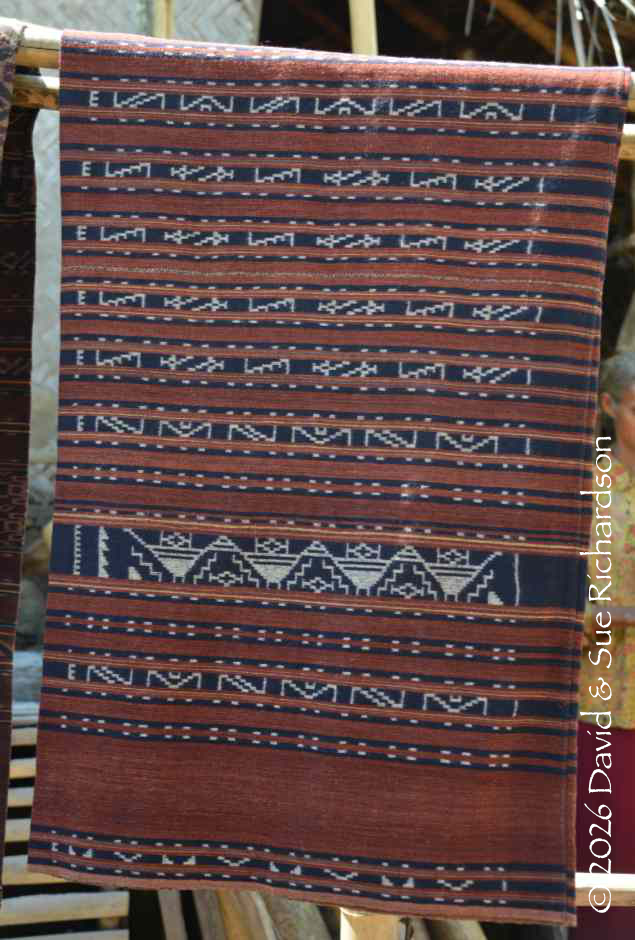
A modern petak alé drying on a washing line in Watuwawer
Ruth Barnes described the petak alé as a ‘woman's sarong tied around the waist'. According to Hanna Fricke, alé is simply the term for waist in the Central Lamaholot dialect (Fricke 2019, 522). Therefore, the term petek alé translates as ‘waist sarong’. Interestingly, in Watuwawer (formerly Atakore) some of the women call them petak alun, alun being the term for waist in Western Lamaholot.
Today, two-panel sarongs made from synthetically dyed commercial yarn are still referred to as petak alé. However, the majority no longer have the main ikat bands dyed in two colours, white and black.
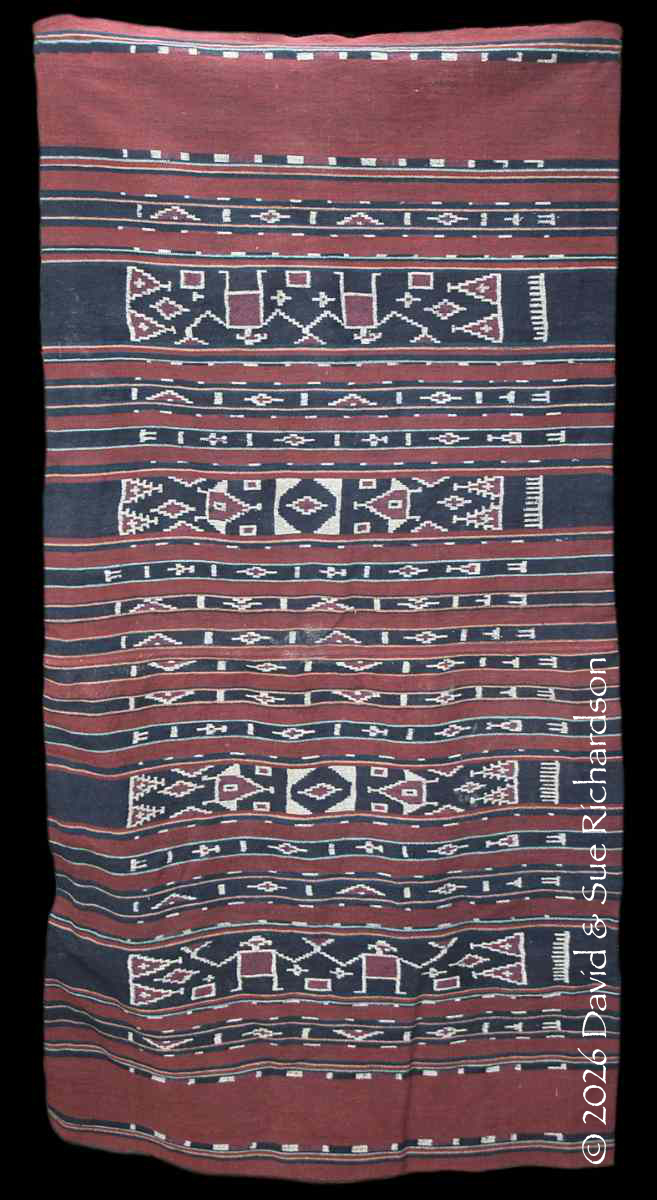
A synthetically dyed petak alé belonging to a weaver in Lerek
Indeed, the majority of these sarongs bear no resemblance to the petak alé of the past.
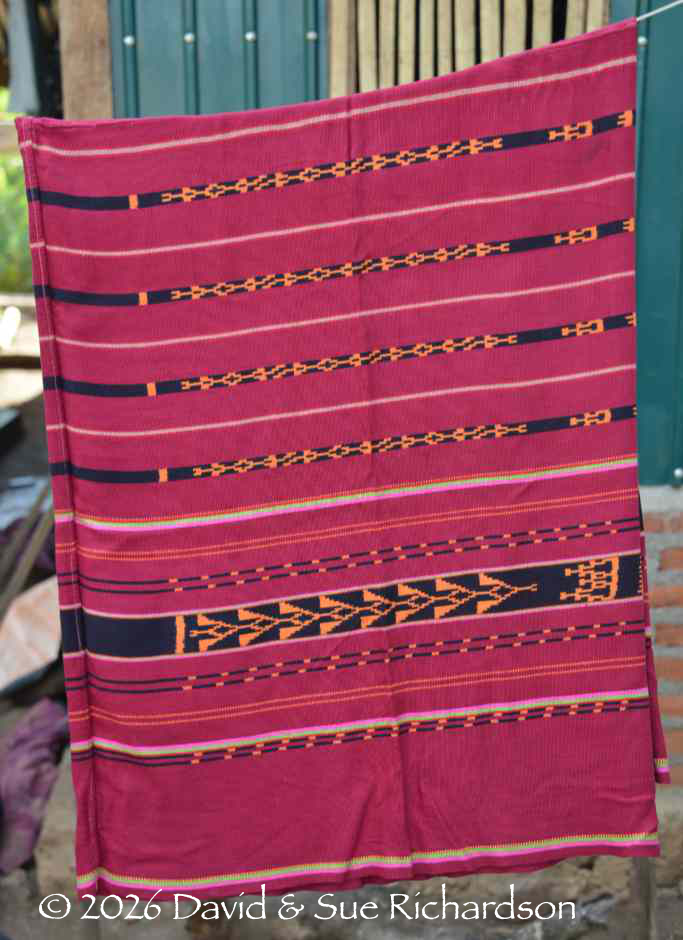
Above: A simple synthetically dyed sarong on a washing line in Lerek. Below: Two women drop spinning at Watuwawer wearing modern petak alun.
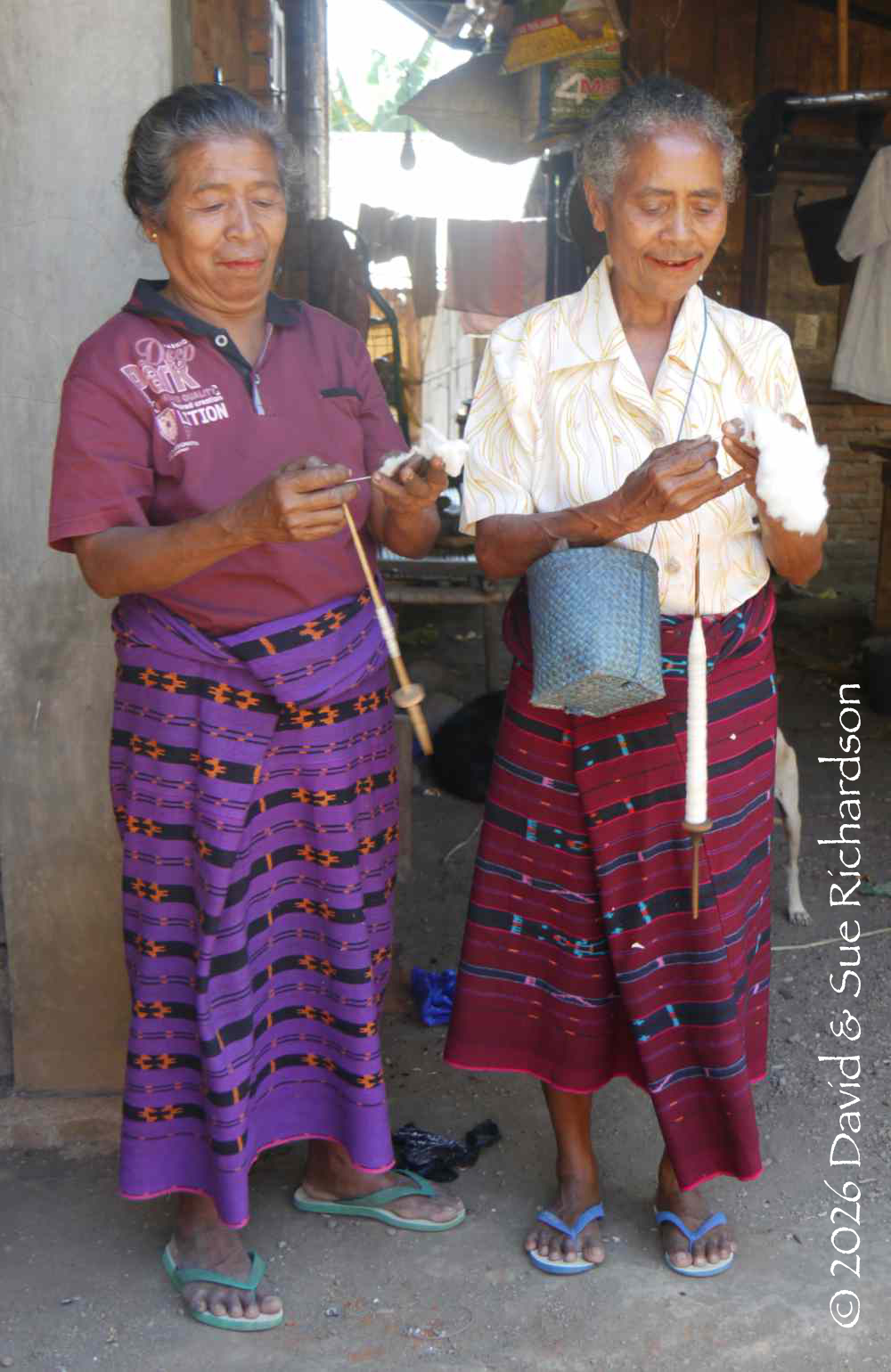
Today, many weavers describe these everyday skirts in different ways. Some simply refer to them as sarong pakai, skirts to be worn. Alternatively others like Mama Maria, who lives in Lerek, described their everyday sarong, made from fine naturally dyed hand-spun cotton as a petak tenane – literally ‘woven sarong’.
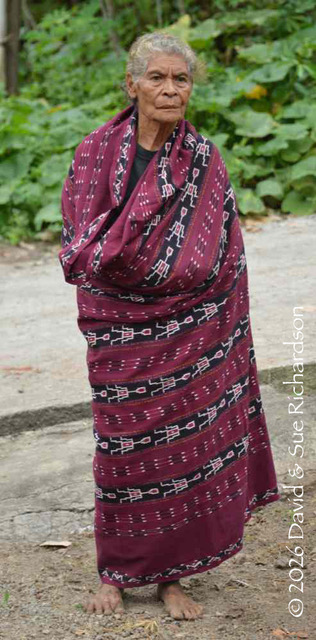
An elderly woman in Lerek wearing her sarung pakai.
Return to Top
Petak Harén
The term petak harén translates as ‘good sarong’.
The traditional petak harén is made from naturally dyed hand spun cotton. The main ikat bands must be dyed with indigo followed by morinda, all of the indigo being overdyed to create a purple-brown near black. It must also have an uncut set of unwoven warps, known on Ata Déi as the wunuren not the revot. It is the only textile on Ata Déi that can be used for bridewealth exchange.
Every example has a pair of longitudinal tram lines down the front of the sarong and a pair of more widely separated tram lines down the back, on either side of the wunuren. These are called kirpain, meaning frame. They indicate where the bundles of yarn passed around each end of the binding frame during the binding process. This feature is not found on the textiles of Ilé Apé.
The kirpain tramlines are often flanked by parallel rows of tumpal motifs called naga koleng, meaning naga tail.
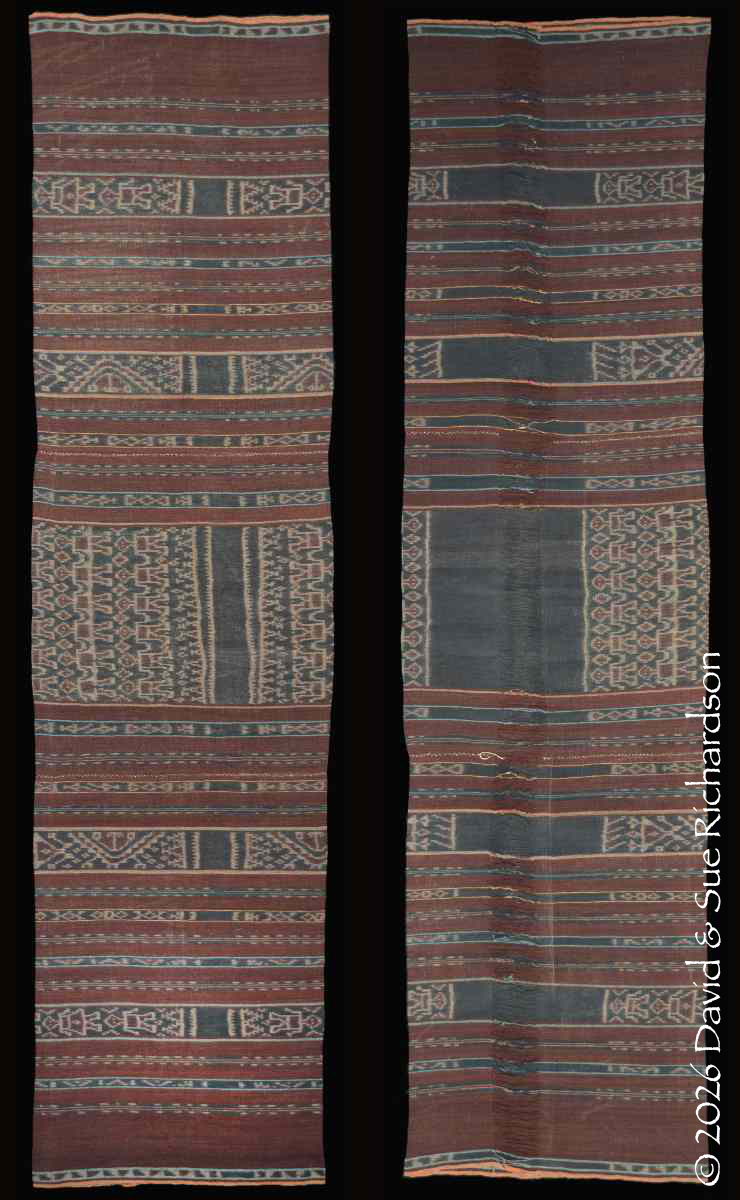
Above: The front and back of a three-panel bridewealth petak harén showing the intact wunuren. Richardson Collection.
Below: A petak harén with a severed wunuren. Richardson Collection.
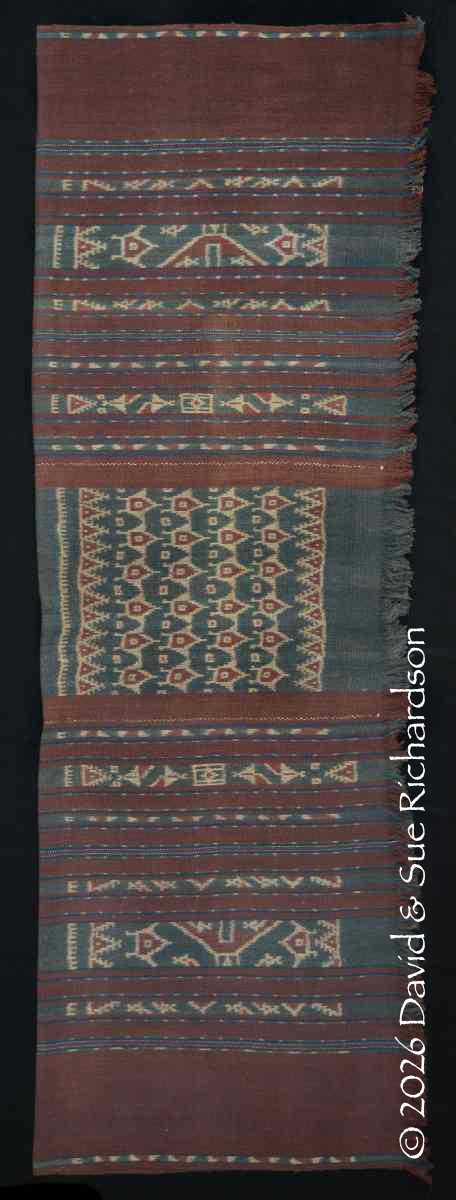
Ruth Barnes wrote that the petak harén only displays three colours – white, black and red (1984, 204). However, many petak harén also contain light indigo blue warp stripes.
Ruth Barnes also added that all adat cloth must have at least three sections, as in the petak harén nai telu (1984, 205). Barnes also claimed that petak harén always had an odd number of panels. Petak harén nai léém were, and still are, produced with five panels and apparently even petak harén nai pito have been made with seven panels although we have never seen one. We have been told that a few weavers have also made four-panel petak harén that have roughly the same proportions as the three elements in the three-panel petak, with two narrow central panels being the same size as anormal central panel.
The two outer panels of a petak harén are called hebak and the middle one (or middle three panels in the case of a five-panel sarong) are called keyenen. The lateral or middle seams are called reiteng. The ends of each outer panel terminate with a plain band of morinda and a narrow outer ikat band known as the hebak topon.
As already mentioned, the unwoven set of warps is called the wunuren not the revot. To be used as bridewealth it is essential that the wunuren remains uncut.
Of course, a three-panel petak harén can also be worn as a high-status garment. They range in length from 1.85 to 2.45 metres in length, so the upper panel must be partially or completely folded down. The skirt can be worn high or lower with a blouse.
Before making a petak harén the weaver must start meditating two weeks in advance. She must then sacrifice a red chicken and put its blood on all of the weaving tools including the drop spindle. If such a sacrifice in avoided, the weaver will get sick or go crazy and the resulting sarong will easily break. Such rituals are not required for making an everyday sarong or a nowin.
The decision to weave a three- or five-panel sarong depends on the negotiated bridewealth exchange. Bridewealth is called pe weling and consists of an elephant tusk. The counter prestation is called pohe and consists of textiles and five kala muku bracelets made of shell tied together. However today many bracelets are made of wood. While a three-panel sarong is exchanged for a normal tusk a five-panel sarong is exchanged for a big tusk for a higher status educated woman. However, if the mother of the bride really loves her daughter, she might give a five-panel sarong even though she only receives a small tusk. This freedom for the mother to decide what size to give is not available on Ilé Apé, because the woman cannot overrule the decision of the clan.
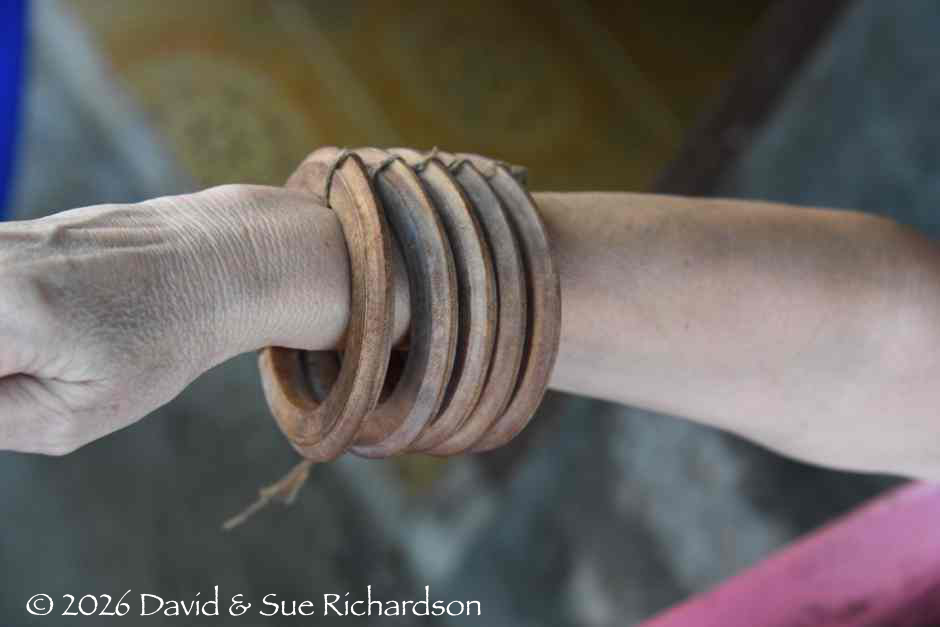
A set of wooden bracelets tied together in Atawolo
Return to Top
Petak Harén Nai Telu
The three-panel petak harén nai telu has relatively long end panels and a narrower middle panel. The latter is always decorated with a lattice of smaller motifs, which are mainly limited to simple diamonds (kapunaken), manta rays (mokung) or anthropomorphic figures (ata diken). Despite this, every example seems to be unique.
The following four petak harén nai telu with diamond lattice patterns (known as kapunaken) all have their wunuren intact. In most cases, the small diamonds enclose a tiny rectangle. The first contains manta rays in its main outer band and eight-pointed star motifs, known as hiret or hireten, in its main inner band. This latter motif appears to be found in Atawolo and nearby hamlets.
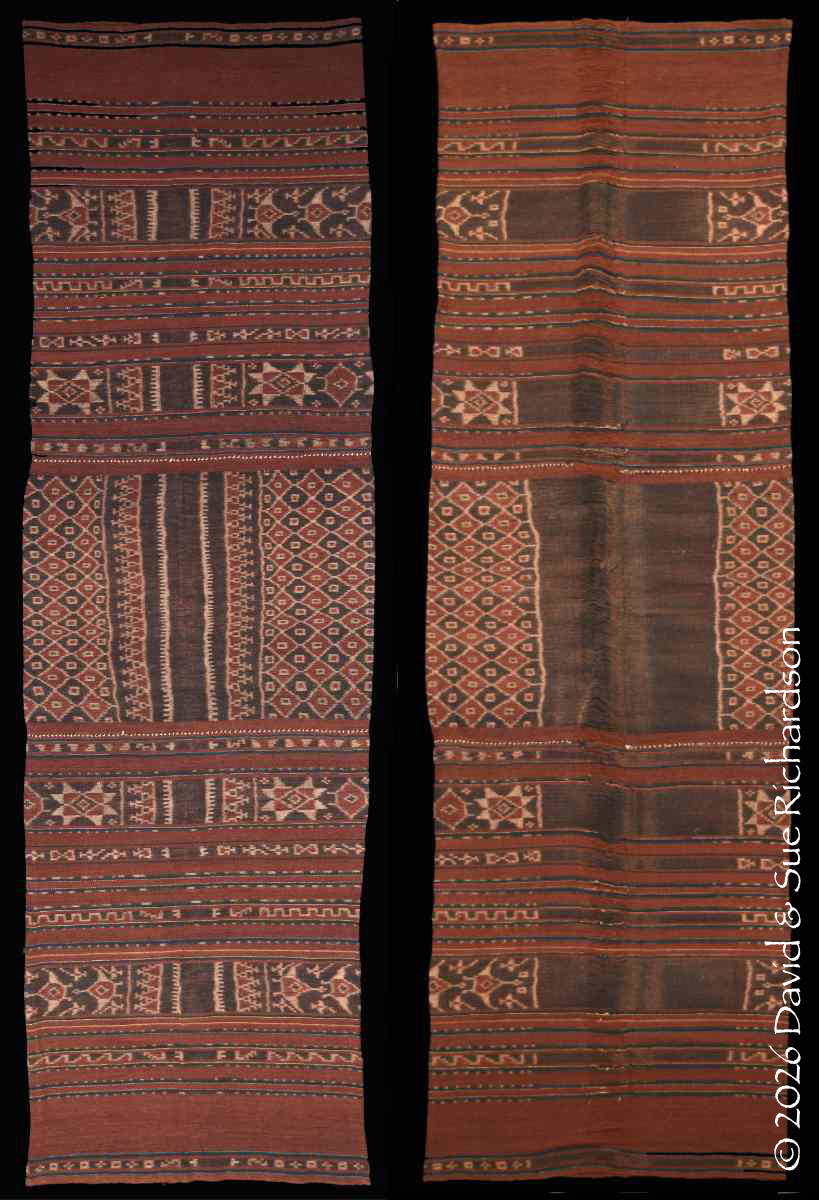
A petak harén nai telu with the star-shaped hiret motif. Richardson Collection.
The second was made in Watuwawer and contains large v-shaped motifs in its main outer bands. This motif is called tena and represents a cross section of the boats in which many of the ancestors arrived from Kroko Pukan, the islands of Lapan and Batan located between northern Lembata and northern Pantar. Tena is the same term for boat used by the sea hunters of Lamalera. One weaver told us that the reason the boat is shown in cross-section is because when their ancestors arrived, their boat was broken.
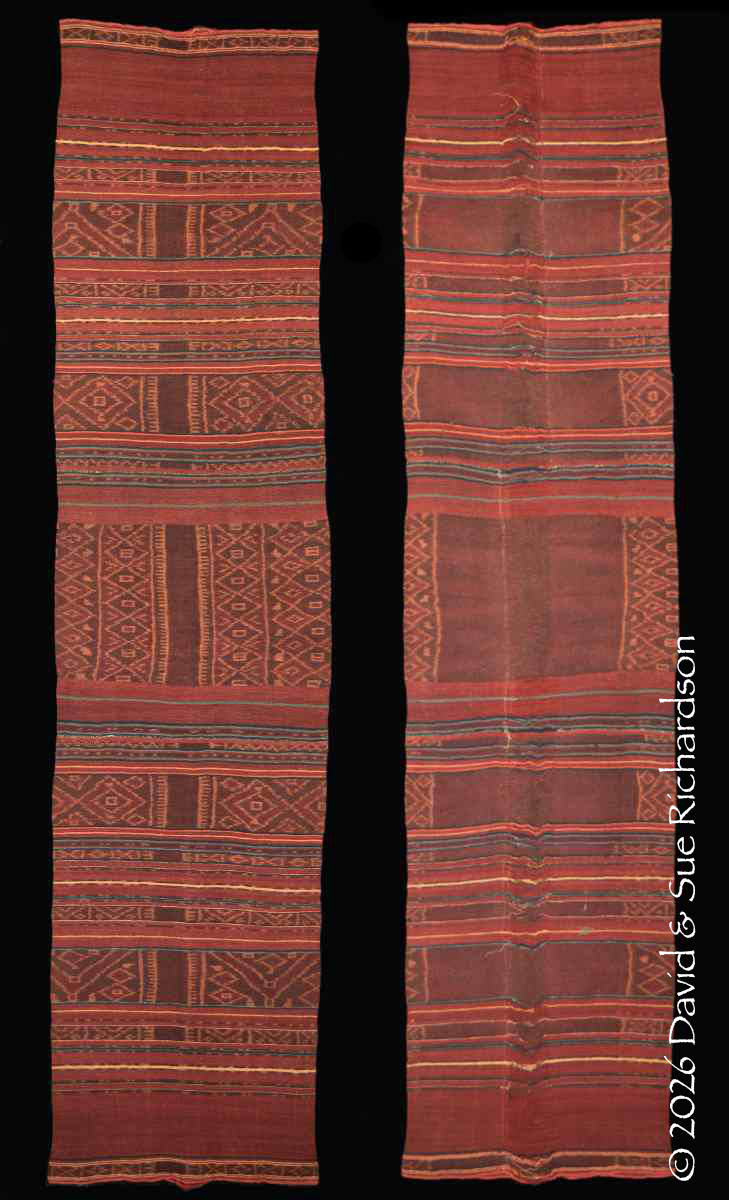
The petak harén nai telu from Watuwawer with the tena motif. Richardson Collection.
The third example was made in around 1905 to 1915 by the late Nenek Rone in the coastal Muslim kampong of Labala in Labala Bay. She was born into a Catholic family in Waiwejak, some 4km from Watuwawer, and belonged to suku Nemang. She married a Muslim man from Labala, Pak Kasan Laba, and converted to Islam, making the sarong after moving to Labala to be with her new husband. It was acquired from Nenek Rone’s great grandson in Lewoleba.
The end panels have two wide bands decorated with large mokumen manta ray motifs, and a small diamond sandwiched between a pair of chevrons.
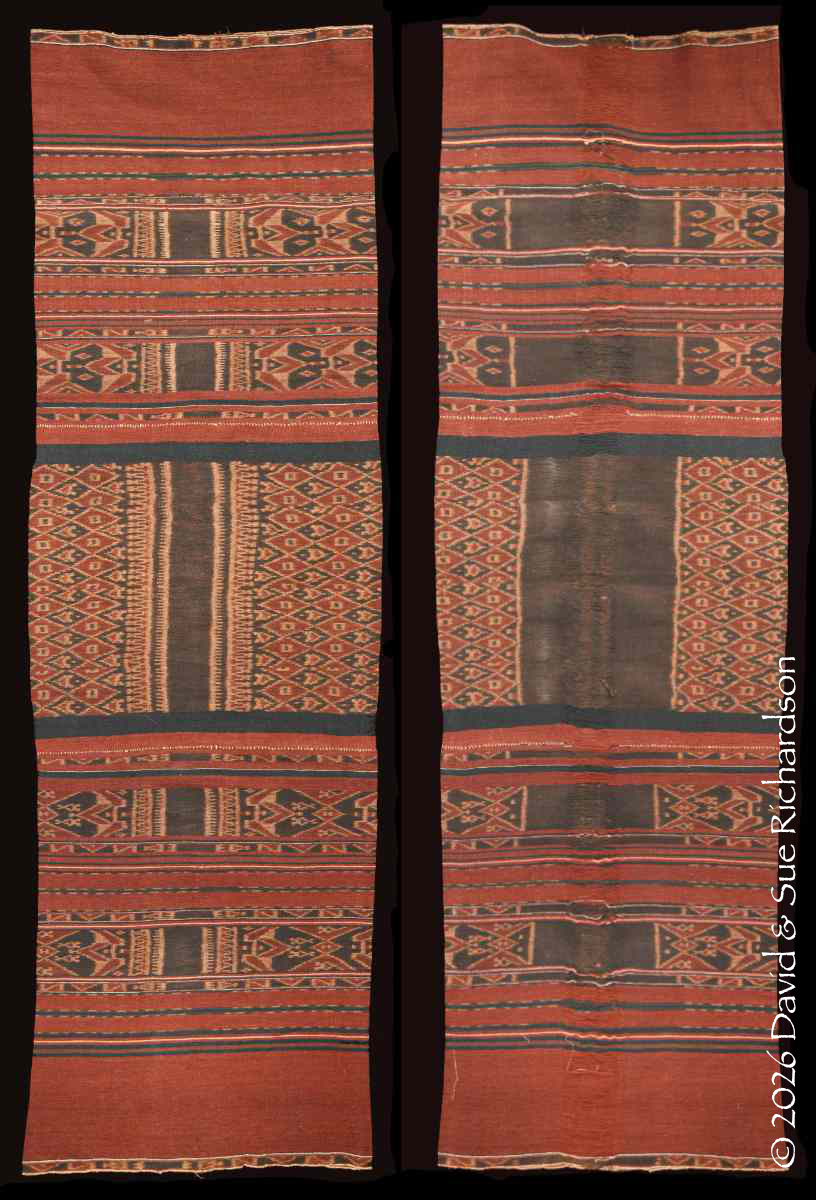
The petak harén nai telu made by Nenek Rone in Labala. Richardson Collection.
The fourth example has no provenance but has a diamond lattice in which each red diamond encloses a manta ray motif and each black diamond encloses a rectangle. It also contains a number of light green warp stripes.
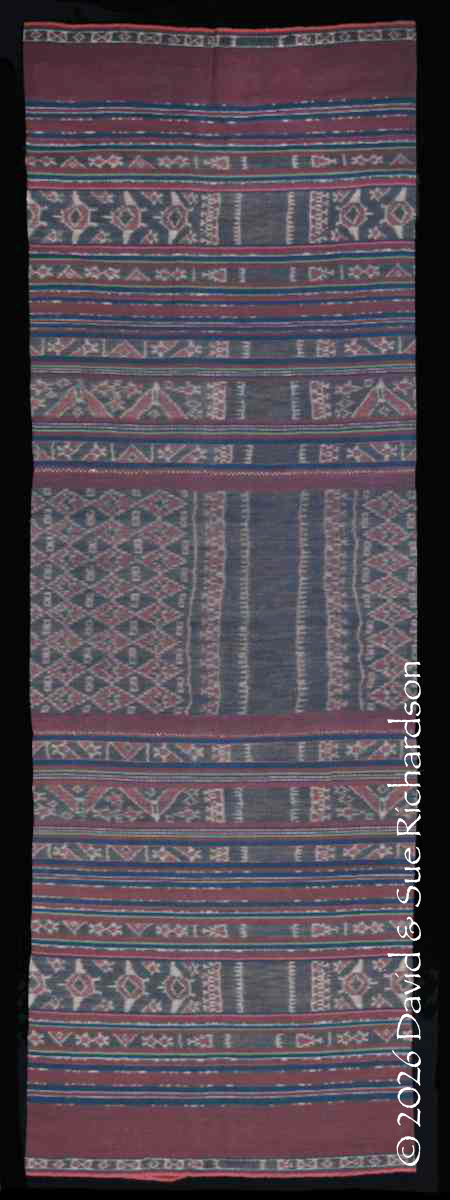
A petak harén nai telu with diamonds enclosing small manta rays. Richardson Collection.
We were shown another fine diamond lattice petak harén nai telu in Mulandoro in which each diamond also enclosed a manta ray motif.
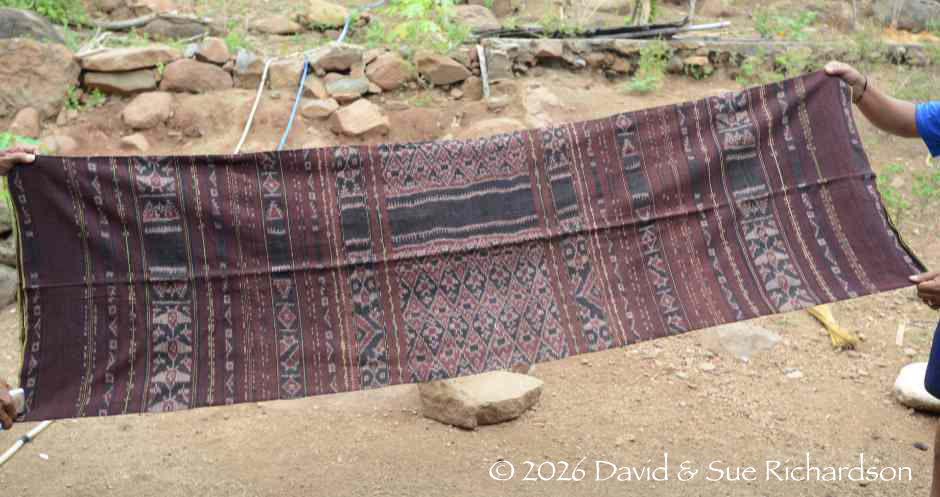
The following three petak harén nai telu have lattices containing small manta ray (mokung or mokumen) motifs. According to the sea hunters of Lamalera, these motifs represent a specific kind of manta ray known as devil whiptail ray, sometimes called the spinetail devil ray, which has a distinct pair of horns.
It is strange that a community of highland farmers should depict a specific marine animal in their textiles. Many of the residents of Ata Déi believe that some of their ancestors were seafarers who arrived after fleeing a tsunami on the Lapan Batan Islands, which happened some 500 years ago. However, since then, their descendants have abandoned any connection to the sea, probably because the coastline of Ata Déi is too hostile to permit fishing. A more credible explanation is that in the past, the women of Lamalera would walk to villages on Ata Déi wearing their traditional sarongs to barter their whale meat and fish, but not their textiles, in return for vegetables (Barnes 1984, 203; Barnes 1996, 145-146). This tradition is known as penata or penetang (Peni 2021). As such, the women of Ata Déi would be exposed to the designs of Lamalera, especially the distinctive mokung motif.
The first two examples of devil whiptail ray lattice petak harén nai telu have no provenance. The first has a severed wunuren and a large tena in its outermost main band. The second has yellow and pale blue warp stripes.
Above and below: Two petak harén nai telu with ray lattices. Richardson Collection.
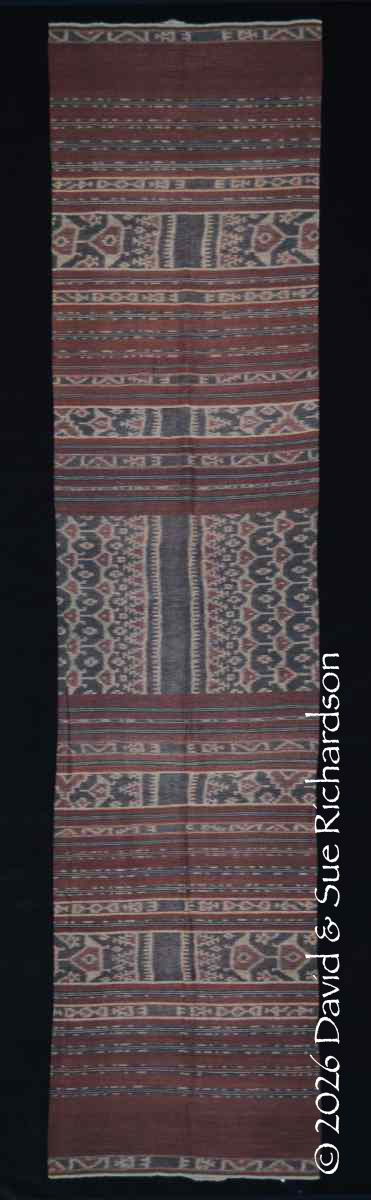
The third devil whiptail lattice petak harén nai telu was made in Watuwawer. It has a lattice of large rays, mokung kédak, interspersed with tiny sunfish (kebeku). The skirt also contains warp stripes that have been dyed cream, sky blue and khaki green, the latter possibly from turi leaf.
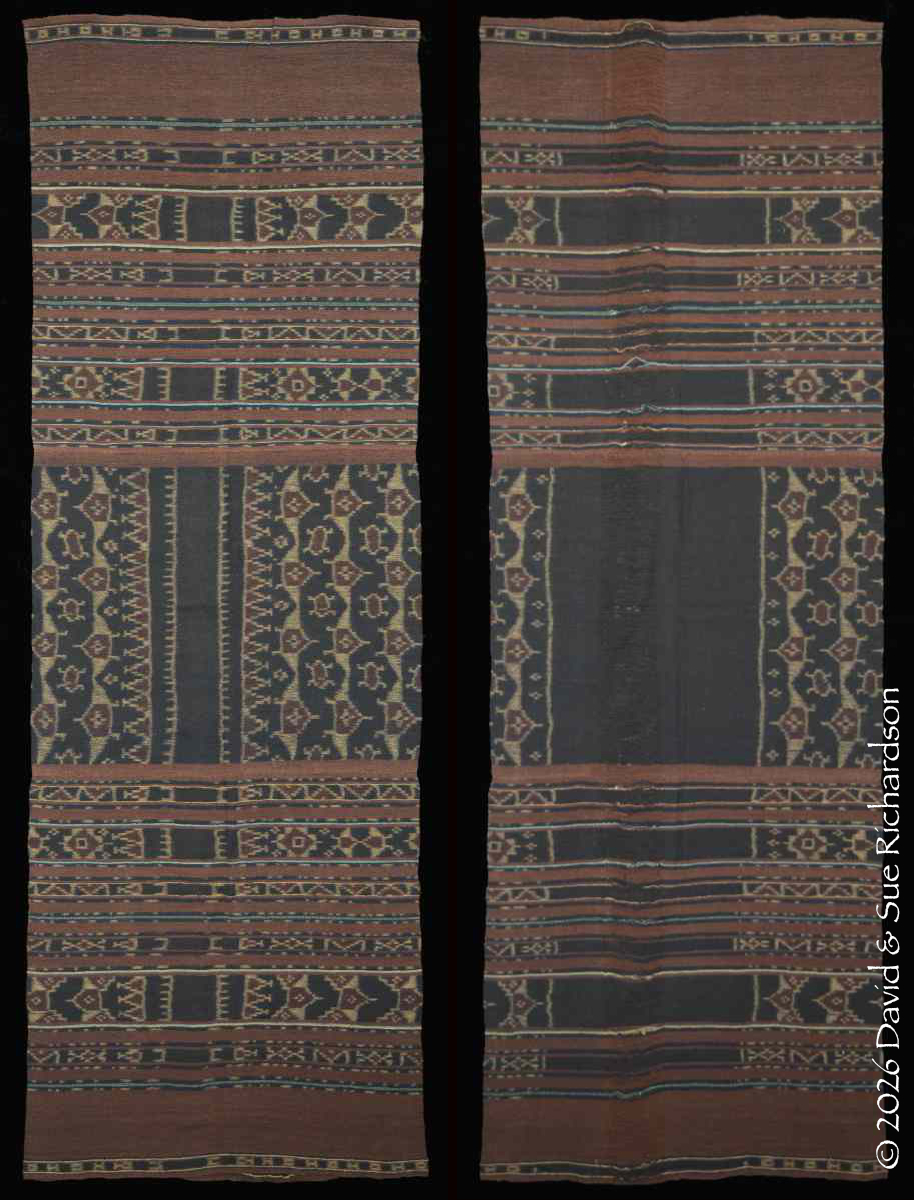
A petak harén nai telu made in Watuwawer. Richardson Collection.
One final example of a devil whiptail ray lattice petak harén is held in the collection of the Met Museum, New York.
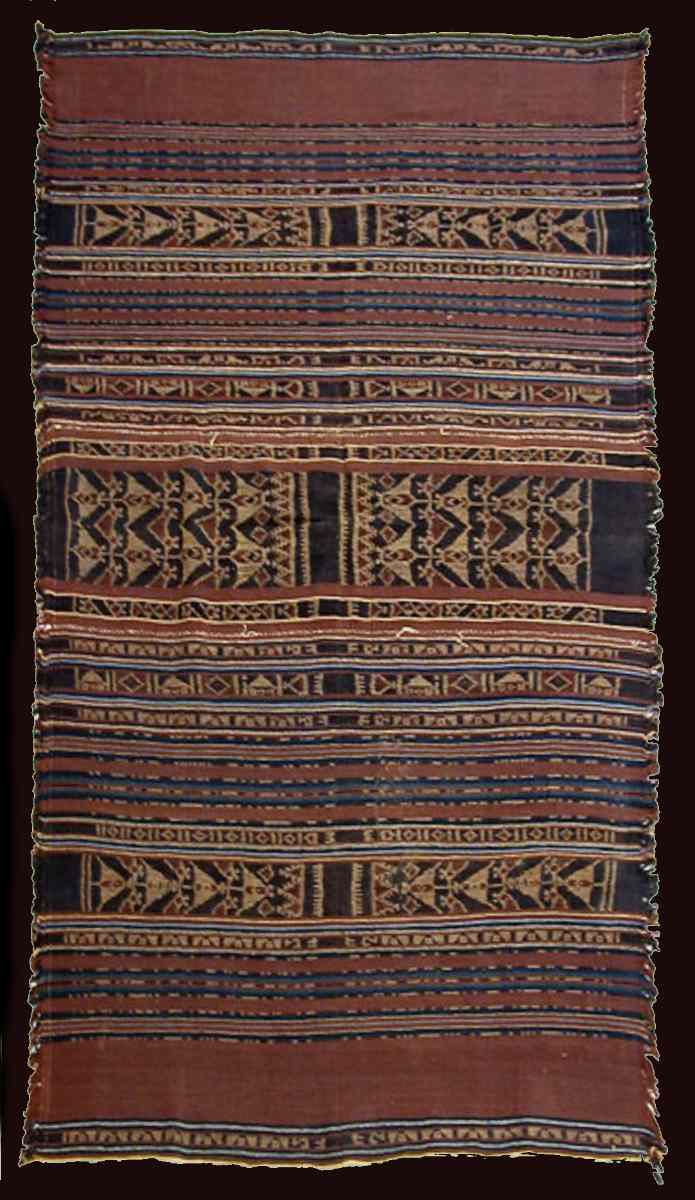
A petak harén nai telu from the Met Museum.
The final category of petak harén nai telu are decorated with a central lattice composed of rows of stick-like anthropomorphic figures (ata diken) apparently holding hands. This pattern is called dolo dolo although some villagers refer to it as tula lia. This represents the traditional Lamaholot circular dance that is performed by the villager community for weddings and important festivals, such as when they celebrate a harvest festival, build a new house or open a new garden. It is a symbol of social harmony.
The very first petak harén that we collected on Lembata Island in 1991 was of this type. Unfortunately, the seller had already cut the wunuren, so that the cloth could no longer be used for bridewealth exchange. In the outer panels, one ikat band contains volcanoes and manta rays, while another contains more stick people and a larger volcano.
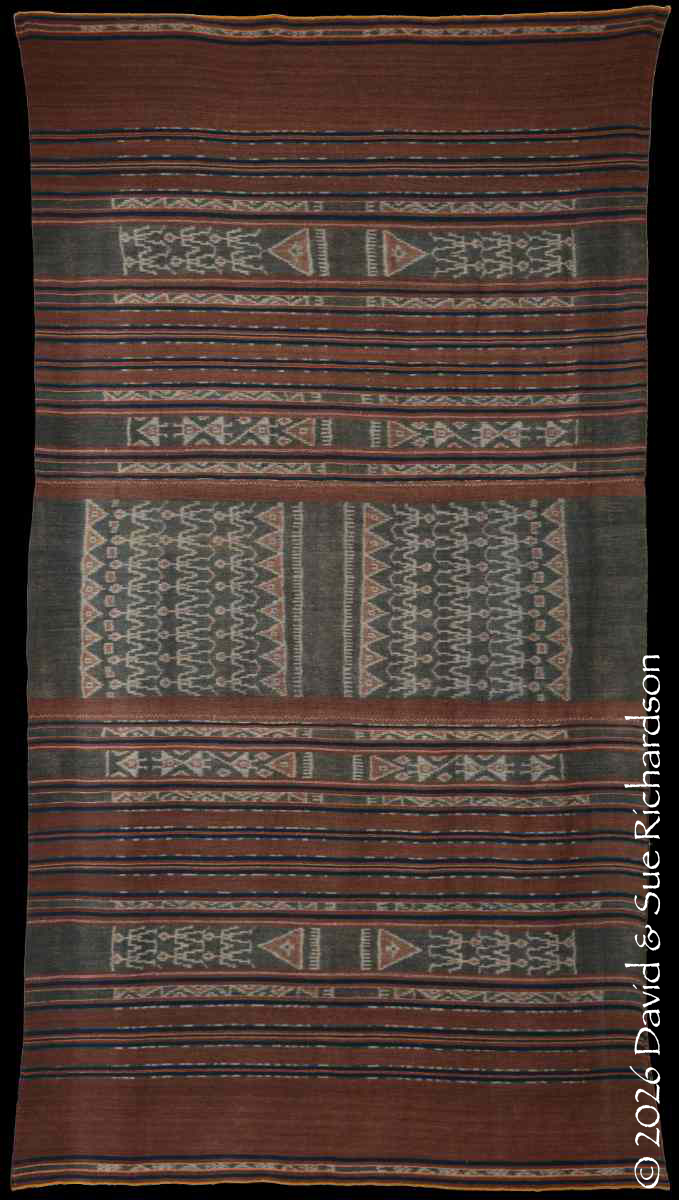
A petak harén nai telu with the dolo dolo pattern collected in 1991. Richardson Collection.
The second example is also without provenance. The central panel has two rectangular lattices, each containing three rows of six male figures (ata dikan – man) holding hands. It is guarded by two narrow ikat bands containing pairs of small mokung ray motifs. The outer panels contain two main ikat bands – the outermost has alternating male and female figures, while the innermost has large ray motifs and a v-shaped cross-section of a tena boat with two protruding oars.
A petak harén nai telo with male and female anthropomorphic figures. Richardson Collection.
The third example of a petak harén nai telo with the dolo dolo pattern was made by the mother of Julie Lajar from the Lajar clan who was born in Watuwawer but moved to Lewoleba after she was married. Julie’s mother belonged to suku Lejap and died in Watuwawer in 2009 whilst in her 90s. Julie could still remember that her mother occasionally wore it when she was a young girl. In this sarong all of the anthropomorphic figures appear to be male.
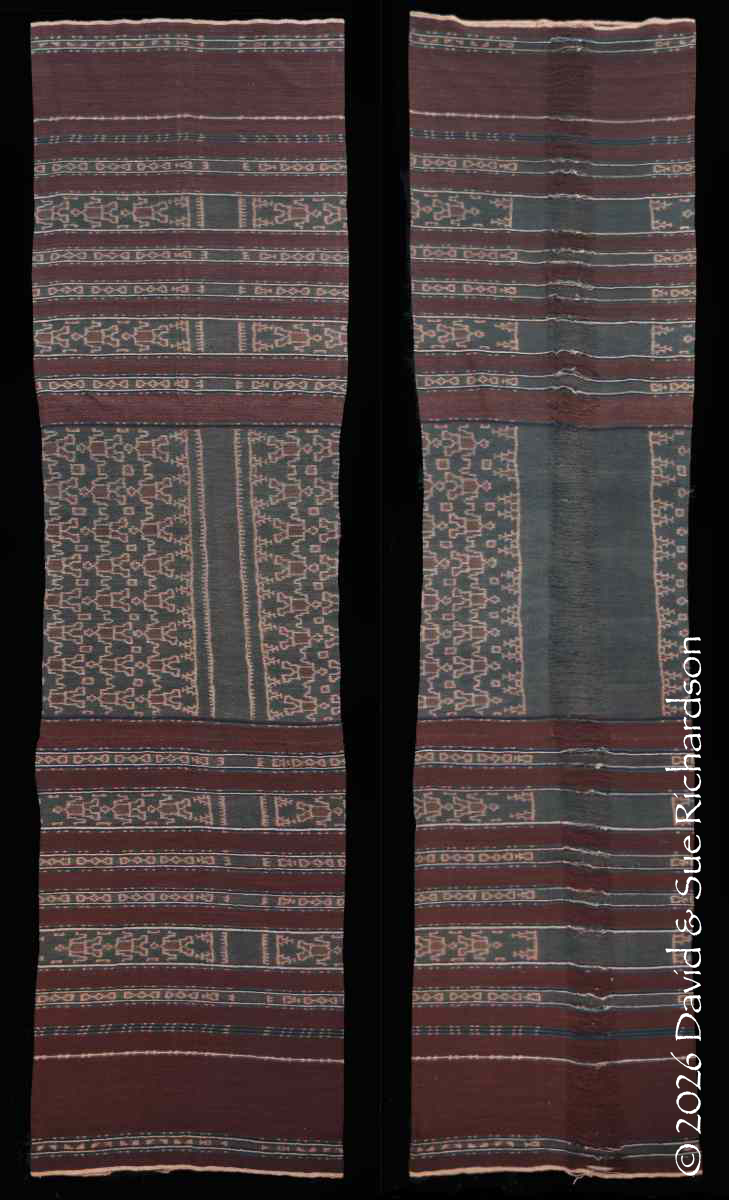
A dolo dolo petak harén nai telo made prior to 1965 in Watuwawer.
Richardson Collection.
The next example of a petak harén nai telo with the dolo dolo pattern was made in 1995 by Ana Tada from Lusilame, formerly known as Atawolo. She was born in 1940 and belonged to suku Henakin. It was made with the intention of being used for a marriage counter-prestation but was never actually used for that purpose. The unwoven wunuren is still intact. The sarong was acquired from the maker’s daughter.
The anthropomorphic figures in this petak are far more stylised and have arrow-shaped heads.
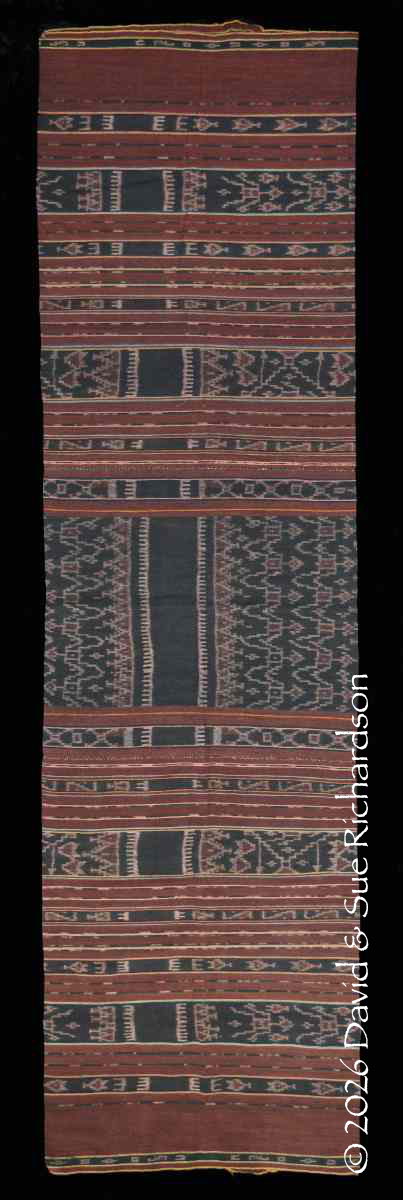
A dolo dolo petak harén nai telo made by Ana Tada in Lusilame. Richardson Collection.
The final example was made in the year 2000 by Alberta Jaga Watun from Lerek. She belonged to suku Watun and lived with her husband Simon at the top of the village, close to the church. The sarong was made with the intention that it would be used as a marriage counter prestation, but Alberta decided that it was better to sell it and make a replacement. This petak has very angular anthropomorphic figures with arrow-shaped heads and shield-shaped bodies. The outer end bands have a row of large ray motifs (mokung) accompanied with small ray motifs with angled tails. The inner end bands have a row of adjacent diamond motifs, known as kapunaken.
Alberta told us that before making this petak there was a special ceremony in which the ancestors were asked their permission for her to weave this particular pattern. Before and after she had made this pattern she is not be allowed to eat any of the new corn from the fields.
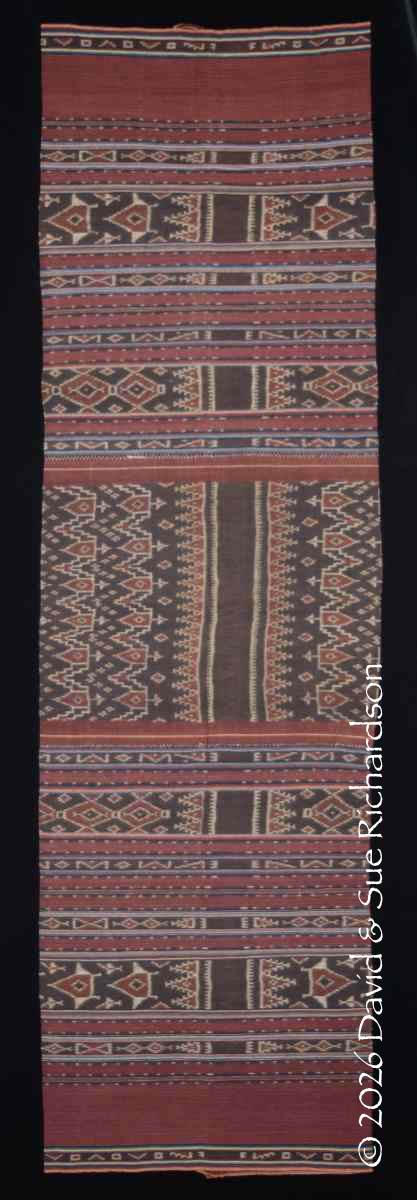
A dolo dolo petak harén nai telo made by Alberta Jaga Watun in Lerek.
Richardson Collection.
According to Limono (2021), dolo dolo petak harén can only be woven by women who have inherited the pattern through their maternal lineage. Weavers who inherit this ikat pattern are obliged to observe a lifelong abstinence of eating black rice, black sugar cane, and sun fish (kebeku).
In addition to these three main pattern categories, there are many other individualistic designs of petak harén nai telu. Some can be quite dramatic. The following example was photographed in Lerek in 2004. The central panel depicts a large tena motif, with the cross section of the boat hull and three pairs of projecting oars. The outermost main ikat band is decorated with sunfish (kebeku).
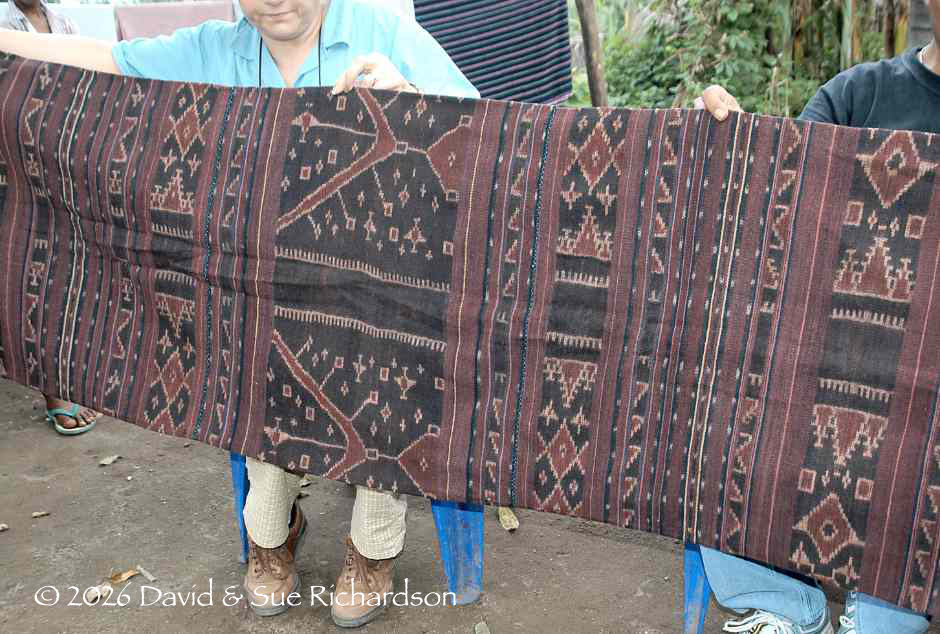
Sue holding a very large petak harén nai telu with the tena motif.
In recent decades many weavers on Ata Déi have abandoned making cloths from naturally dyed hand spun cotton. The three panel sarong shown below was made in 2000 by Mama Naru in Lerek. Despite being made from chemically dyed commercial cotton, she described it as an adat petak harén. Clearly traditions are changing. Whilst some weavers still maintain that they are forbidden to use modern materials to make a petak harén, others have overturned traditions and are working to new rules.
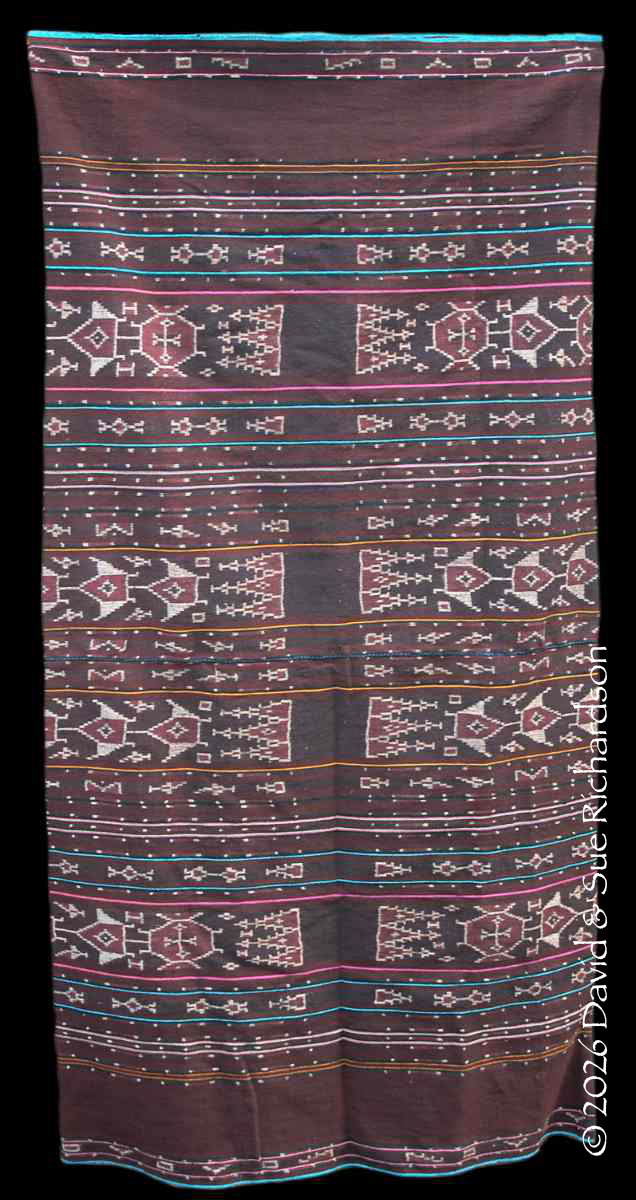
A synthetically dyed petak harén nai telu made by Mama Naru in Lerek
Return to Top
Petak Harén Nai Rua
According to Ruth Barnes:
.... in Lerek [the Ata Déi Peninsula] there are no two-section bridewealth cloths.
On the contrary, we have encountered two-panel petak harén nai rua in villages such as Waiwejak, Watuwawer and Lerek. Indeed, weavers in Lerek told us in 2004 that all adat cloth (woven from naturally dyed hand spun cotton) was called petak harén, whether it had two-, three- or four-panels.
The following petak harén nai rua was acquired from Maria Lejab, aged 65, in Lewohala, one of the five Baipito villages on the northwest side of Ilé Mandiri in East Flores. She was born in Waiwejak on Ata Déi in 1954 and married Mus Koten from Lewohala in Malaysia in 1992 before returning to her husband’s village on Flores. Suku Koten supplied the bridewealth of elephant tusks and suku Lejab supplied the counter prestation of textiles, which included this sarong that had been made in Waiwejak.
The main ikat band contains a pair of eight-pointed stars sandwiched between triple tumpals on each side. The owner called this morning star motif a patala, the Ilé Mandiri term for star. On Ata Déi they call the eight-pointed star motif hirat.
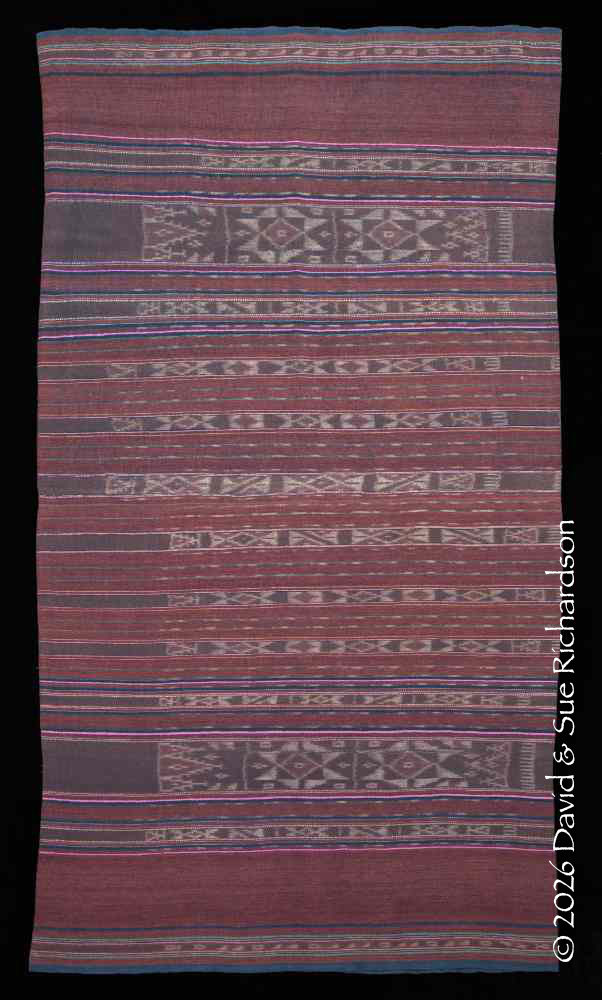
The petak harén nai rua from Waiwejak. Richardson Collection.
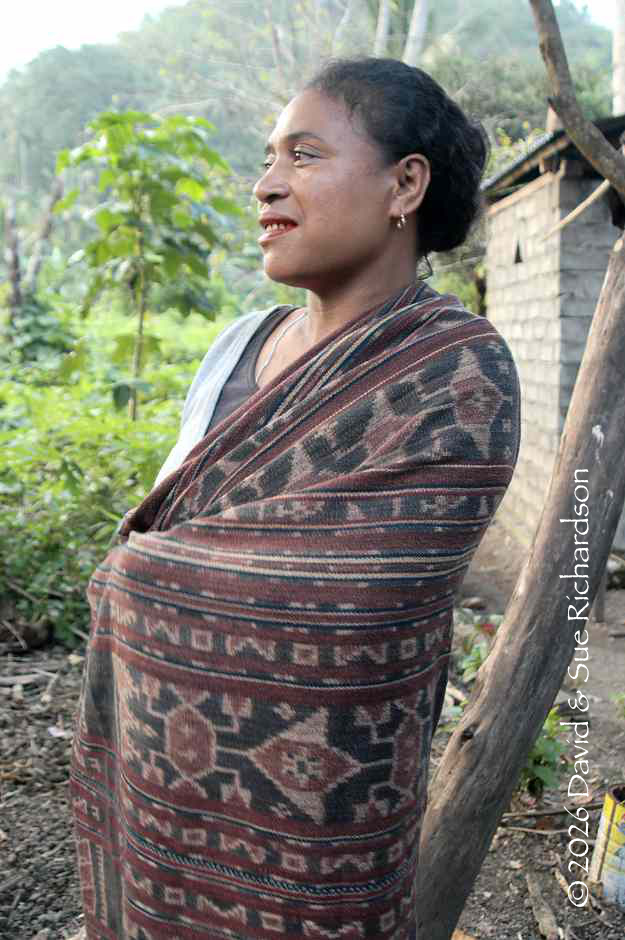
The next example was acquired in 2004 from the wife of a former kepala desa of Lerek, whose name and clan we overlooked to record. She informed us that it was a petak harén that had been worn to go to church but could still be used as part of the dowry, gifted from the woman’s family and clan to the man’s family and clan.
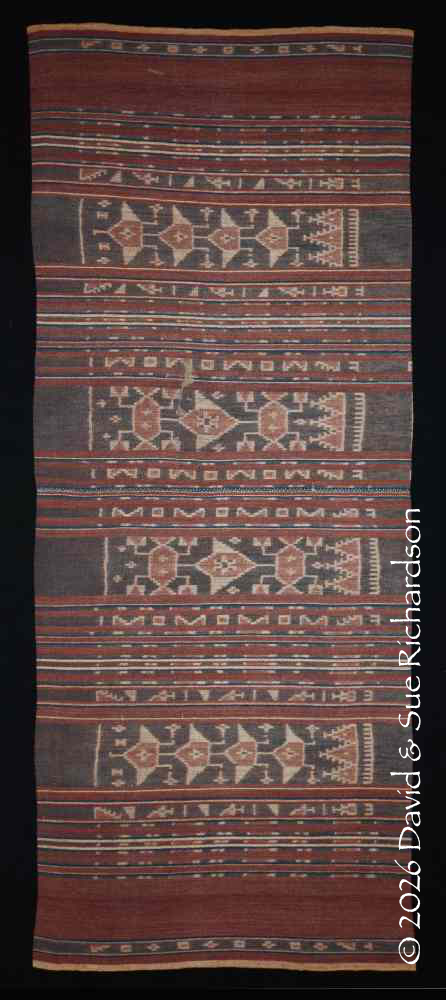
Above: The petak harén nai rua from Lerek. Richardson Collection.
Below: The weaver displaying her petak in Lerek
The third example has no provenance although weavers on Ata Déi have suggested to us that it definitely comes from the upper mountain area of Ata Déi, from somewhere like Lewokroma just below Watuwawer, Atawolo or Lerek. The main ikat band in each panel contains a triad of stepped crosses enclosed by diamonds (kapunaken or ruit), terminated by a double tumpal. It has four narrow pale green bands dyed with utan herani, the leaf of a climbing vine-like bean that grows in the forest.
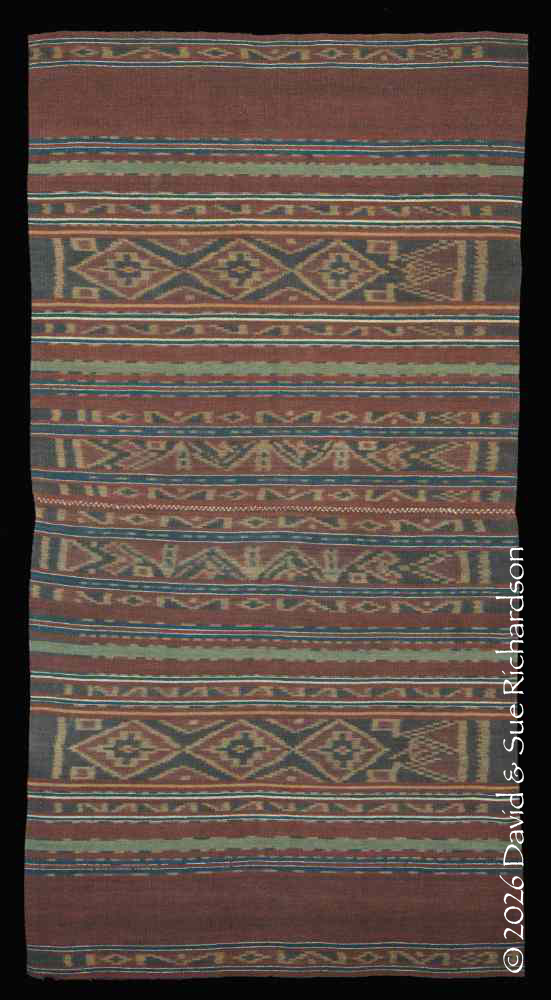
The petak harén nai rua with no provenance. Richardson Collection.
All of the above three petak have had their wunuren removed and replaced with a rolled side seam, breaking another long-standing tradition.
Return to Top
Petak Kwae Tuan
Whilst some weavers on Ata Déi believe that it is possible to use a two-panel sarong made from naturally dyed hand spun cotton for bridewealth, others do not. Thus, in the village of Watuwawer the women told us that a petak harén must either have three- or five-panels. Such sarongs were adat and could either be used for bridewealth exchange or could be worn for special occasions.
However, they still make two-panel sarongs made from naturally dyed hand spun cotton, which they call a petak kwae tuan, kwae meaning wife and tuan meaning husband. Such skirts are not adat and can be worn anytime, to church or for festivals, but cannot be used for brideweath. They also insist that it is forbidden to use modern materials to make a petak harén.
In 2025 Emiliana Pulo showed us two petak kwae tuan that she had made in 2003. In each one the wunuren had been severed and removed and replaced with a rolled side seam. The second one has narrow light blue warp stripes dyed with peheleman.
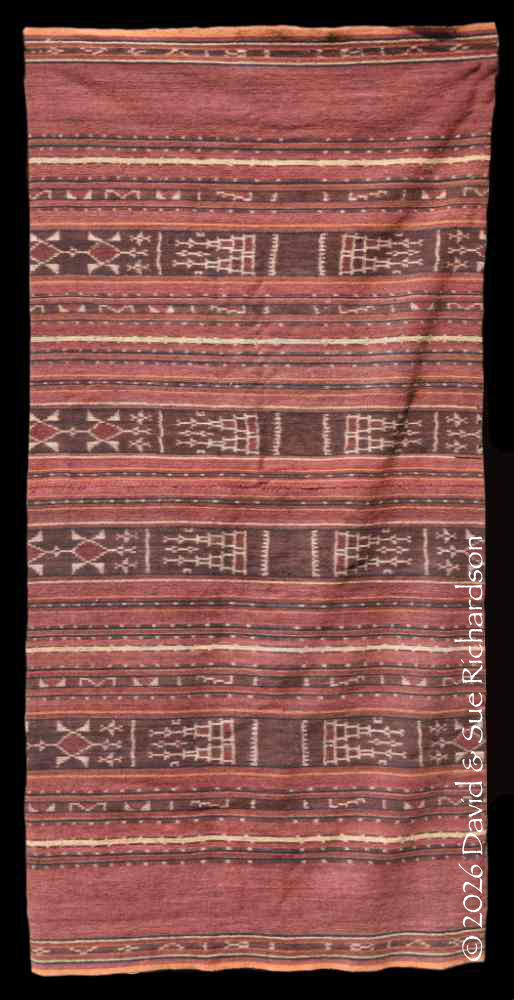
Above and below: Two naturally dyed petak kwae tuan made in 2023 by Emiliana Pulo in Watuwawer
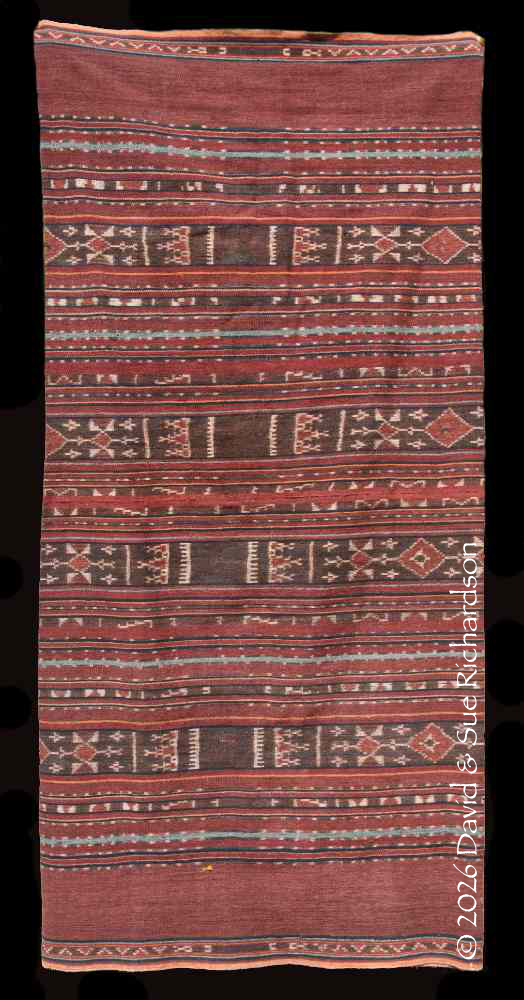
The following two-panel petak kwae tuan was made in 2005 by Marta Mua Lejap in Watuwawer. Born in 1946 she was married at the age of 28 and immediately had her first baby. Before marriage she had helped her mother with the weaving processes, but only began to take on the full ikat making process after she had her first child. After that she completed a petak harén or petak kwae tuan every year.
Unlike the majority of Ata Déi petak, Marta chose to not overdye all of the indigo. Consequently, many of the motifs have light blue indigo detailing. In addition, the sarong has many light and dark blue indigo warp stripes. Each panel is almost completely filled with narrow warp stripes and narrow bands of three-coloured ikat. The main ikat band is decorated with pairs of mokung ray motifs and the v-shaped tena motif with oars.
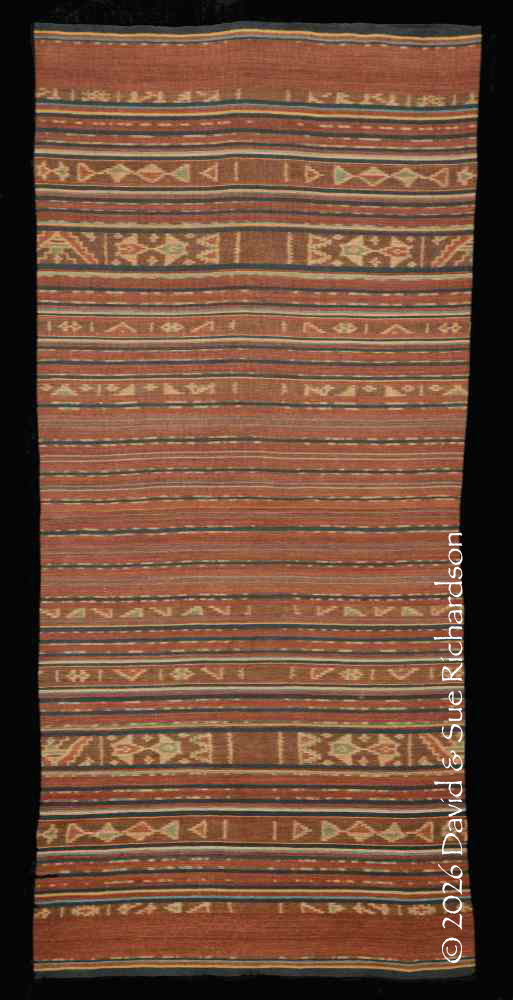
Above: The petak kwae tuan made by Marta Mua Lejap in Watuwawer. Richardson Collection. Below: Marta wearing her petak kwae tuan
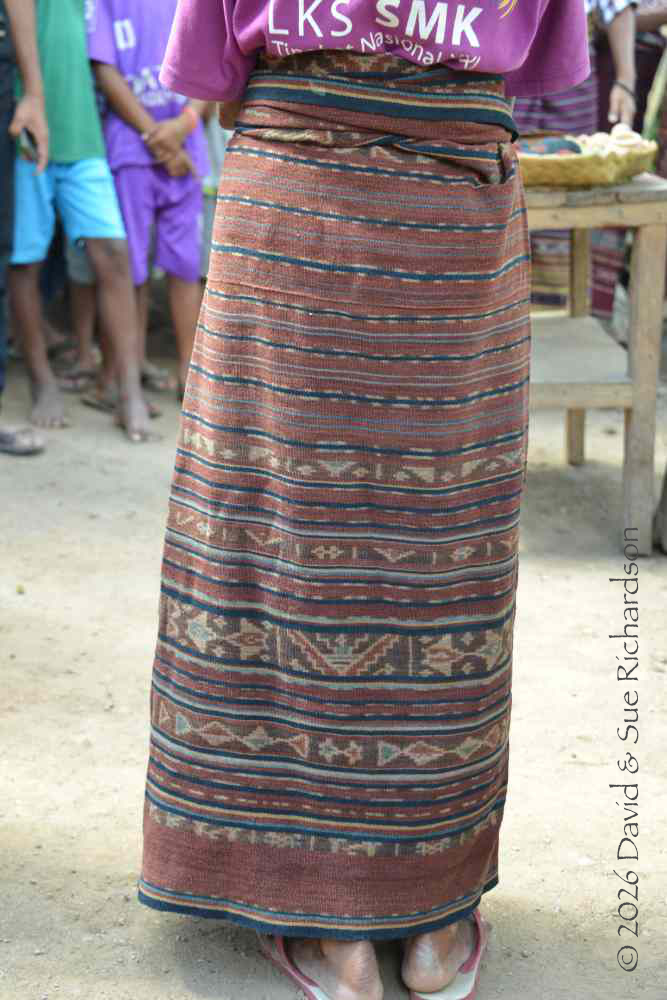
Return to Top
Petak Harén Nai Léém
The five-panel adat sarong is called a petak harén nai léém (pronounced ‘lem’). They are relatively rare compared to the three-panel version.
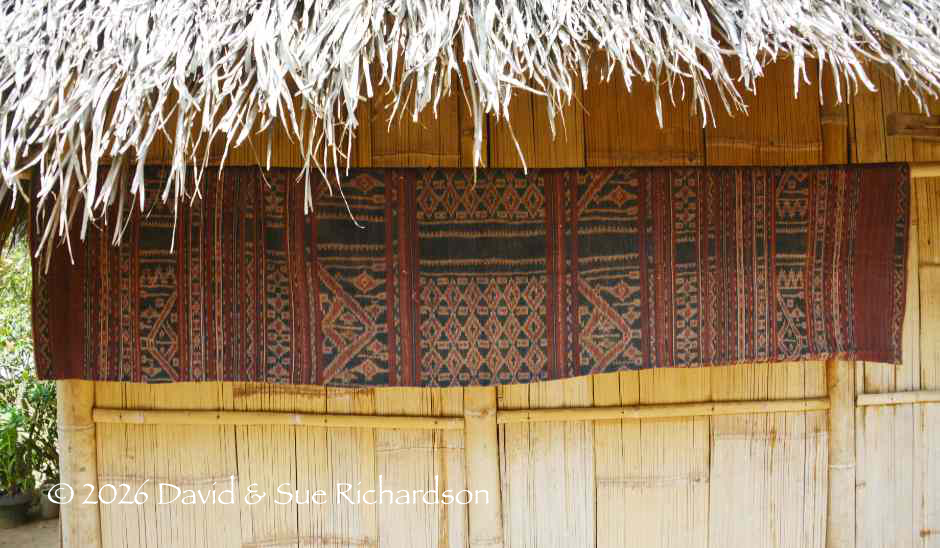
A coarsely woven petak hare nai léém on display in Watuwawer.
Clearly completely impractical to be worn as a skirt, these textiles are made for the soul reason of being used as a counter prestation in the bridewealth gift exchange. Villagers tell us that while a petak harén nai telu would be exchanged for a standard tusk, a petak harén nai léém would be exchanged for two tusks or one large tusk. However, if the mother of the bride really loved her daughter she might give a five-panel sarong even though she only received a small tusk. This freedom for the mother to decide what size to give is not available on Ilé Apé, because there the woman cannot overrule the decision of the clan.
The five-panel sarong can also used as a funeral shroud.
The following petak harén nai léém was woven in 2008 by Katarina Ero Tolok in the village of Lusilame (formerly Atawolo, meaning the people who live on the hill, the ata woloi). She was born into suku Tolok in 1945 and married a farmer from suku Namang. Sadly he died in 2006. In the triple clan system of alliance, boys from suku Namang marry girls from Tolok, boys from suku Tolok marry girls from Henakin and boys from suku Henakin marry girls from suku Namang.
Lusilame has a population of 341 living in 140 households, out of which there were 60 weavers, all of whom can drop spin.
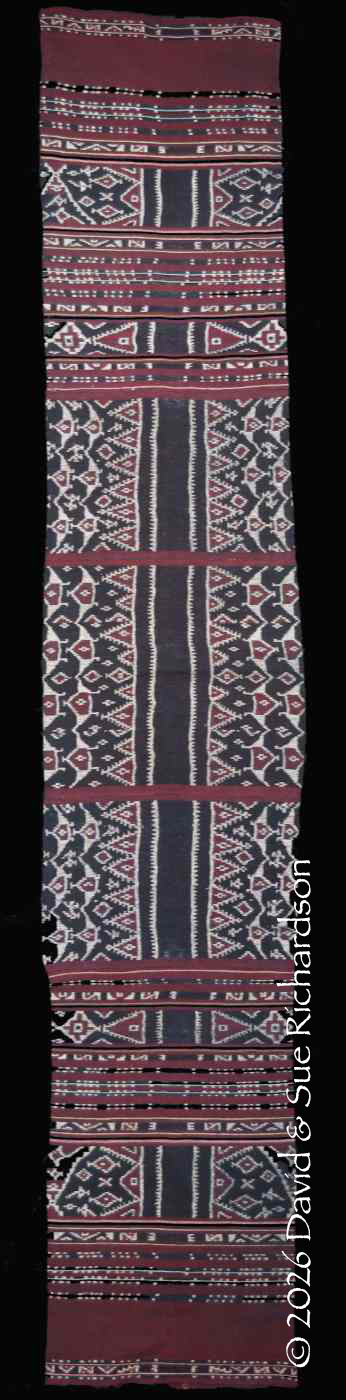
The petak harén nai léém woven by Katarina Ero Tolok in Lusilame. Richardson Collection.
Katerina decided to weave a five-panel sarong because her younger sister had an unmarried daughter and if she decided to get married her family would buy the sarong from her. She explained to us that if her late husband had had a married sister who then died, she would be obliged to donate the sarong as a funeral shroud. The deceased would be dressed in the sarong and then taken to the cemetery and be buried in it.
The next petak harén nai léém has no provenance. The central keyenen panel has two rectangular lattices of thirty mokung ray motifs, arranged in six parallel rows of five. The two flanking keyenen panels have a wide ikat band decorated with two pairs of mokung facing each other, flanked by star-shaped motifs that look like a pair of merged ray motifs.
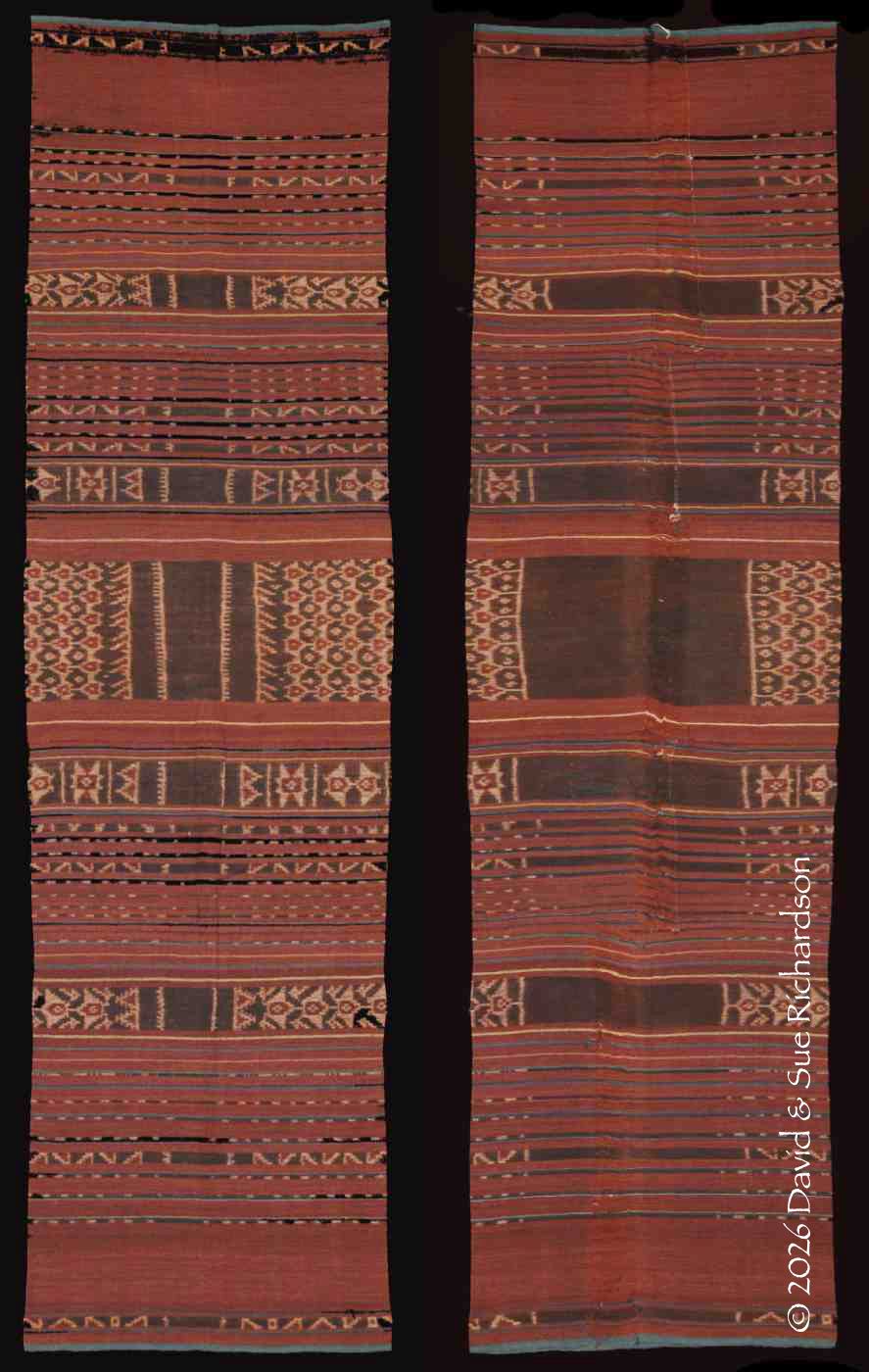
The petak harén nai léém decorated with ray motifs. Richardson Collection.
Weavers informed us that a petak harén nai léém took two years to make, which is why there are very few of them in the village
Return to Top
Men's Costume
Across Ata Déi today, most men dress in Western-style clothing with shirts or t-shirts, shorts, jeans or trousers. However in the past men wore a two-panel sarong called a nowin. The term nowin is also used in Ilé Api, Lewolein and Kedang but not in Lamalera where the man’s sarong is termed a nofi. Today, the nowin is only worn for formal ceremonies or for attending church. Interestingly, women on Ata Déi also wear a man’s nowin when they perform the war dance.
Most nowin are devoid of ikat and are simply decorated with alternating warp stripes. When weaving a nowin it is not necessary for the weaver to perform the rituals required when weaving a petak harén.
Traditional naturally dyed nowin were sombre in appearance, being decorated with alternating coloured warp stripes.
The following traditional nowin was woven in Watuwawer in 1970 by Teresia Tuto Lejap. Born into suku Lejap in 1948, Teresia married when she was 21 and had her first baby when she was 22. She made this nowin for her new husband in that very same year of 1970.
Woven from finely hand-spun cotton with an indigo weft, it is decorated with a repeating sequence of narrow indigo and morinda bands interspersed with white and yellow stripes. The outer selvages are finished with a narrow band of mustard yellow.
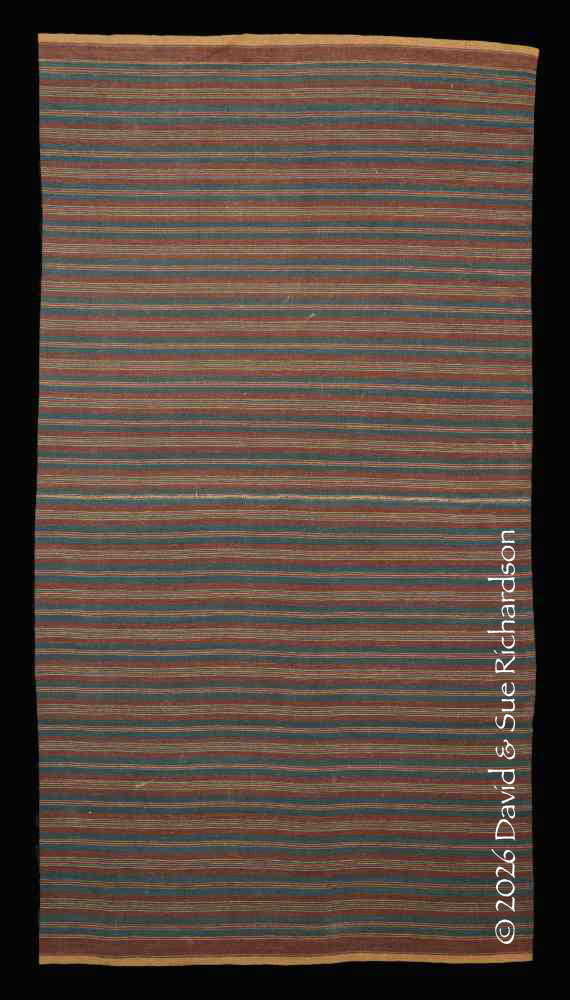
The nowin made by Teresia Tuto Lejap. Richardson Collection
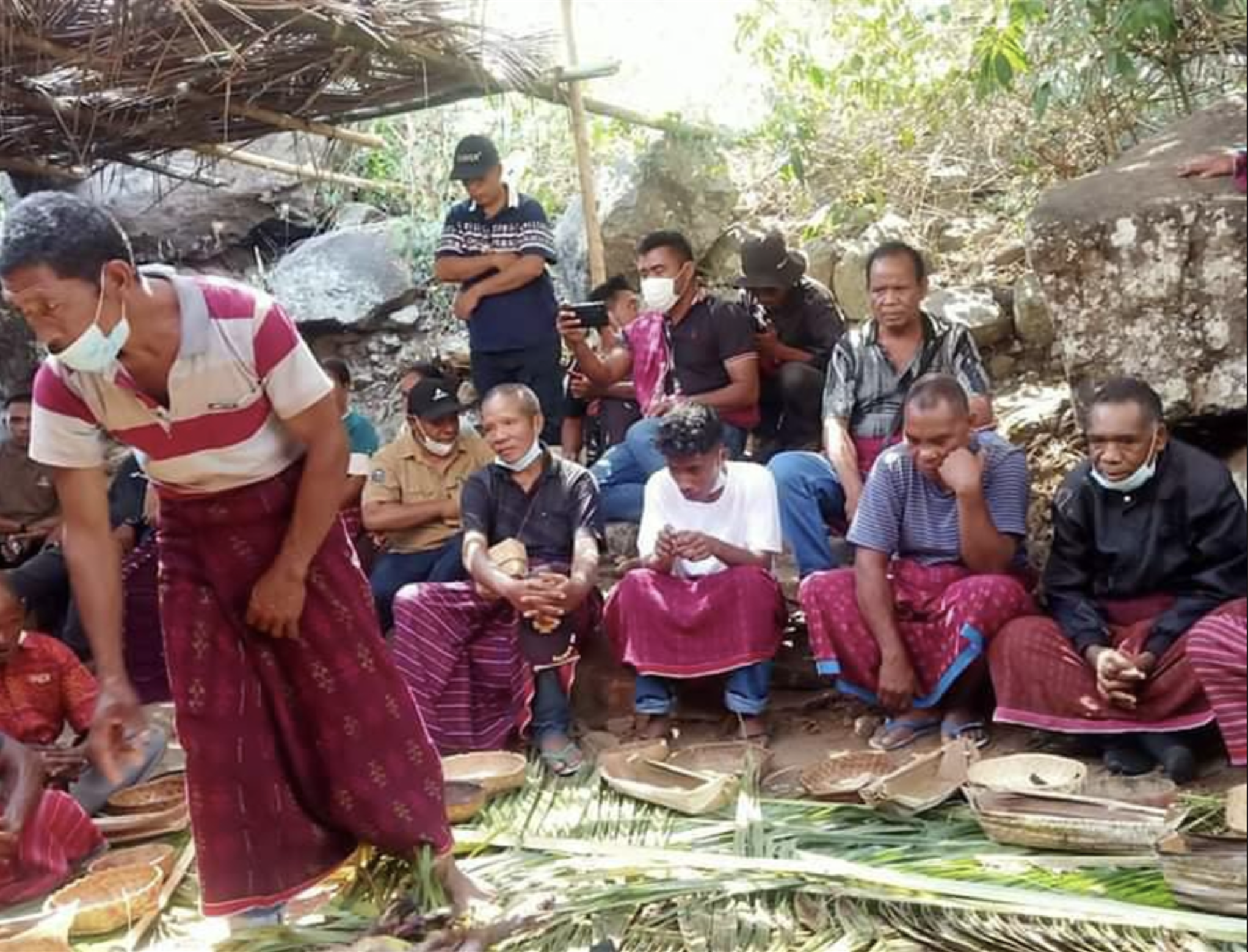
These are now quite rare because today, most men wear nowin woven from synthetically dyed commercial cotton. Most of these are decorated with warp stripes or checks and are predominantly coloured red.
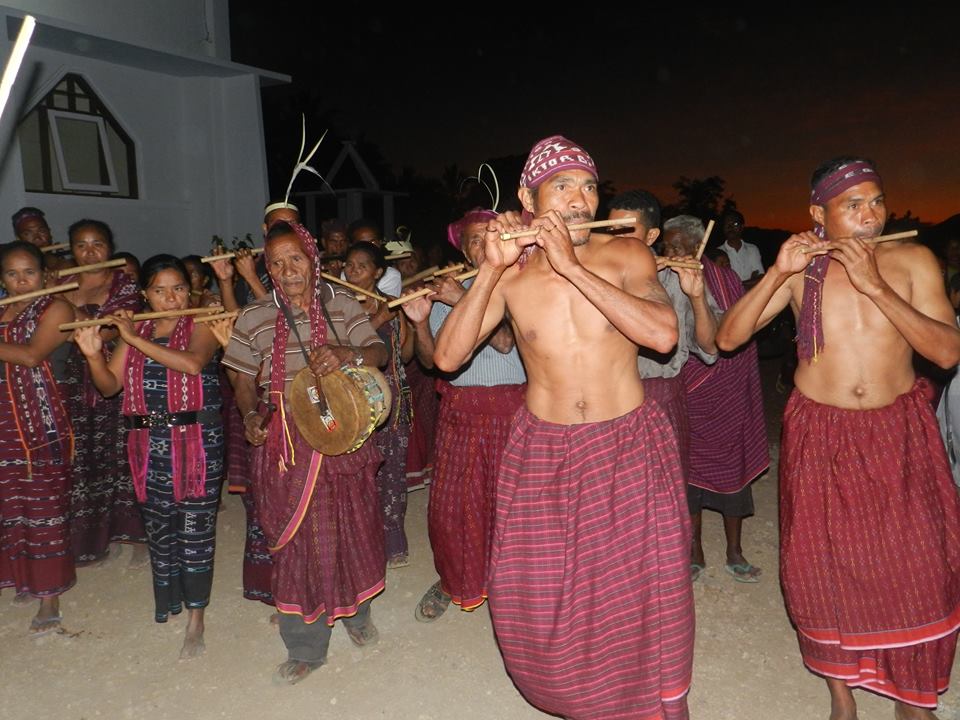
Above and below: Men wearing modern nowin at ceremonies in Atawolo
A popular style of male sarong today is called an ungke and is decorated with simple geometric motifs inserted by means of the continuous supplementary weft technique. These are produced in several villages across Ata Déi. For example, Alex Lajar acquired the following ungke from his aunt, Yuli Karangora, in the village of Ilé Kimok (formery Karang Ora).
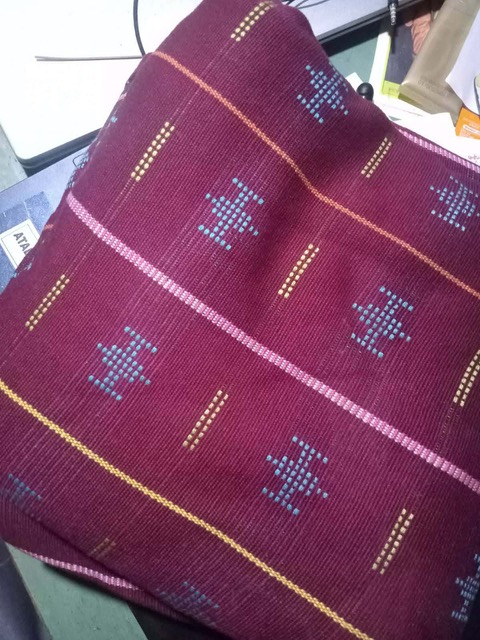
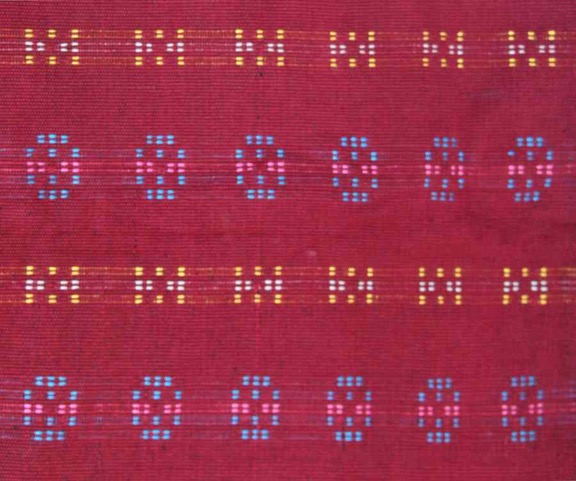
The mystery is that this type of weaving is generally found in western parts of Indonesia such as Sumatra, Lombok and western Flores but is not traditional on Lembata. The technique appears to have been imported in recent decades but it is unclear from where.
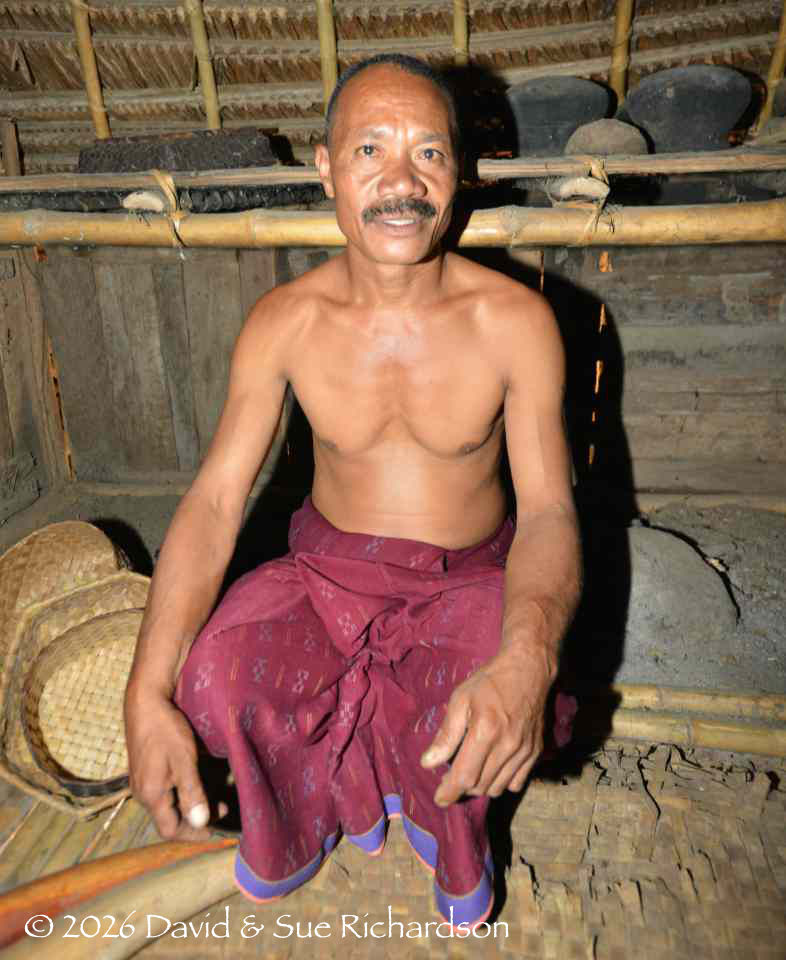
Niko, the keeper of the clan house in Watuwawer, wearing a supplementary weft ungke.
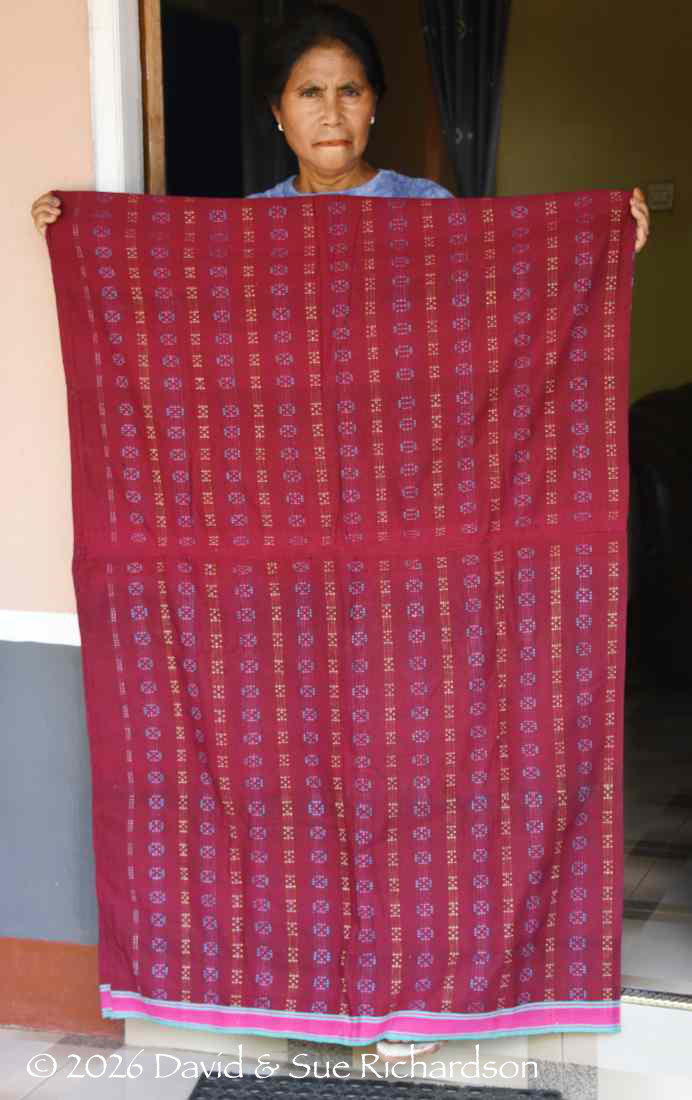
Above and below: A modern ungke decorated with continuous supplementary weft.
Return to Top
Bibliography
Ataladjar, Thomas B., 2015. Pai Hone Tala Ia, Pai Wane Tele Pia, Lame Lusi Lako dari Tanah Nubanara Menuju Tanah Misi, Koker, Jakarta.
Barnes, Robert Harrison, 1996. Sea Hunters of Indonesia: Fishers and Weavers of Lamalera, Clarendon Press, Oxford.
Barnes, Ruth, 1989a. The Ikat textiles of Lamalera: a study of an Eastern Indonesian weaving tradition, E. J. Brill, Leiden.
Barnes, Ruth, 1989b. 'The Bridewealth Cloth of Lamalera, Lembata', in To Speak With Cloth: Studies in Indonesian Textiles, Gittinger, Mattiebelle, (ed.), University of California, Los Angeles.
Barnes, Ruth, 1991b. 'Patola in Southern Lembata', Indonesian Textiles. Symposium 1985, Völger, Gisela and Karin von Welck (eds.), Ethnologica Neue Folge, Band 14, Cologne.
Barnes, Ruth, 1992. 'Textile Design in Southern Lembata: Tradition and Change', Anthropology, Art and Aesthetics, ed. Jeremy Coote, pp. 160–178, Clarendon Press Oxford.
Barnes, Ruth, 1993. 'Change and Tradition in Lamaholot Textiles: The Ernst-Vatter-Collection in Historical Perspective', in Weaving Patterns of Life: Indonesian Textiles Symposium 1991, Nabholz-Kartaschoff, Barnes and Stuart-Fox (eds.), Museum of Ethnography, Basel.
Barnes, Ruth, 2004. Ostindonesien im 20. Jahrhundert: Auf den Spuren der Sammlung Ernst Vatter, Museum der Weltkulturen, Frankfurt.
Beckering, J. D. H., 1911. Beschrijving der eilanden Adonara en Lomblem, behoorende tot de Solor-Groep, Tijdschrift van het Koninklijk Nederlandsch Aardrijkskundig Genootschap, 2e Série, vol. 28, pp. 167-202.
Fricke, Hanna, 2019. Kamus Tiga Bahasa Atadei Demon ‒ Indonesia ‒ Inggris, Unit Bahasa & Budaya, Kupang.
Limono, Lusiana, 2021. Rekonsialisasi Dalam Tenun: Sebuah Kisah Dari Atadei, Lembata, Blog, Borobudurwriters.
Peni, Lusia, 2021. Perempuan Lamalera dalam budaya penetang, Jurnal Agama, Pendidikan, dan Budaya, vol. 2, no. 1, pp. 1-11.
Vatter, Ernst, 1932. Ata Kiwan: unbekannte Bergvölker im tropischen Holland, ein Reisebericht, Bibliographisches Institut, Leipzig.
Return to Top
Publication
This webpage was published on 20 February 2026.